Invention and Engineering
Gallium
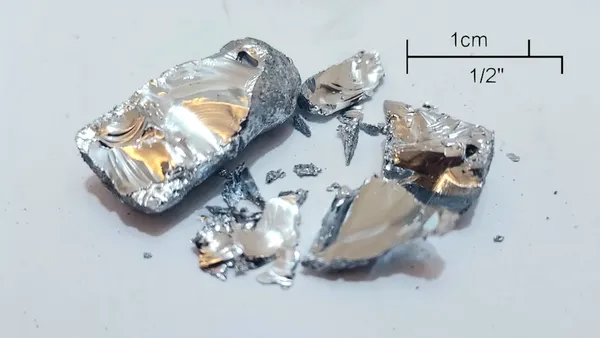
Gallium is a chemical element; it has symbol Ga and atomic number 31. Discovered by the French chemist Paul-Émile Lecoq de Boisbaudran in Paris, France, 1875, elemental gallium is a soft, silvery metal at standard temperature and pressure with a complex orthorhombic crystal structure. In its liquid state, it becomes silvery white. If enough force is applied, solid gallium may fracture conchoidally. Gallium does not occur as a free element in nature, but rather as gallium(III) compounds in trace amounts in zinc ores (such as sphalerite) and in bauxite. The melting point of gallium, 29.7646 °C (85.5763 °F; 302.9146 K), is used as a temperature reference point. One of only four metal elements that is liquid at, or near, normal room temperature, gallium will melt in a person's hands at normal human body temperature of 37 °C (99 °F). Gallium alloys with low temperatures are used in thermometers as a non-toxic and environmentally friendly alternative to mercury, and can withstand higher temperatures than mercury. A melting point of −19 °C (−2 °F), well below the freezing point of water, is claimed for the alloy galinstan (62–95% gallium, 5–22% indium, and 0–16% tin by weight), but that may be the freezing point with the effect of supercooling. Gallium is predominantly used in electronics. Gallium arsenide, the primary chemical compound of gallium in electronics, is used in microwave circuits, high-speed switching circuits, and infrared circuits. Semiconducting gallium nitride and indium gallium nitride produce blue and violet light-emitting diodes and diode lasers. Gallium is also used in the production of artificial gadolinium gallium garnet for jewelry. It has no known natural role in biology. Gallium(III) behaves in a similar manner to ferric salts in biological systems and has been used in some medical applications, including pharmaceuticals and radiopharmaceuticals.
Also on this shelf
GWR Star Class.
Dye-sensitized solar cell.
See also
Uncatalogued shelfText from Wikipedia; plate via Wikimedia Commons. Text CC BY-SA 4.0; plate freely licensed (see Commons). Source record. Images and catalogue data are reproduced from open-access collections.