Writing and Printing
Bouyei language
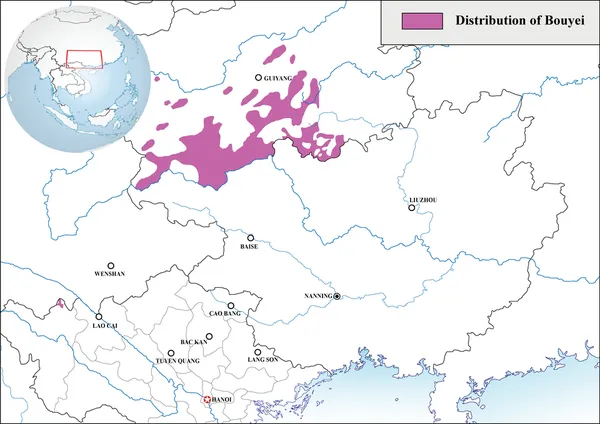
The Bouyei language (autonym: Haausqyaix, also spelled Buyi, Buyei or Puyi; Chinese: 布依语; pinyin: Bùyīyǔ; Vietnamese: tiếng Bố Y or tiếng Giáy) is a language spoken by the Bouyei ethnic group of Southern Guizhou Province, China. Classified as a member of the Northern Tai group in the Tai language branch of the Tai–Kadai language family, the language has over 2.5 million native speakers and is also used by the Giay people (Vietnamese: Giáy) in some parts of Vietnam. There are native speakers living in France and the United States as well, who emigrated from China or Vietnam. About 98% of the native speakers are in China. Bouyei's characteristics are similar to the other members of its language branch. It is generally monosyllabic and word order and particles are the main forms of grammar. Bouyei's syllable initials match up closely to the other Northern Tai languages, with relatively fast simplification and merging. Bouyei sentences can be shown to contain many different levels of phrasing. The contemporary Bouyei script was developed after the abandonment of the Bouyei-Zhuang Script Alliance Policy in 1981 and was designed from 1981 to 1985. It is focused and phonologically representative and takes the Wangmo County dialect as its foundation.
Also on this shelf
Arbeiter-Zeitung (Chicago).
Global spread of the printing press.
See also
Uncatalogued shelfText from Wikipedia; plate via Wikimedia Commons. Text CC BY-SA 4.0; plate freely licensed (see Commons). Source record. Images and catalogue data are reproduced from open-access collections.