Writing and Printing
History of rail transportation in the United States
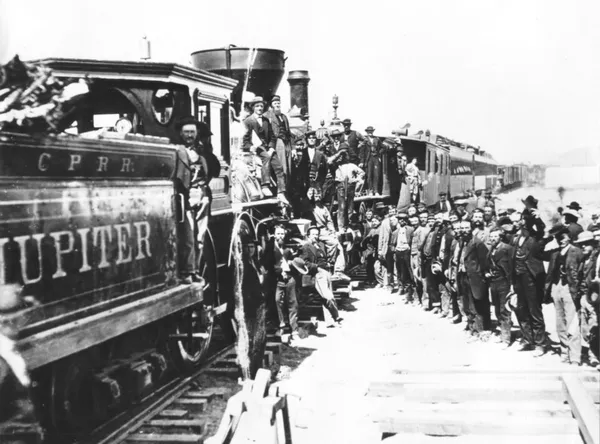
Railroads played a large role in the development of the United States from the Industrial Revolution in the Northeast (1820s–1850s) to the settlement of the West (1850s–1890s). The American railroad mania began with the founding of the first passenger and freight line in the country, the Baltimore and Ohio Railroad, in 1827 and the "Laying of the First Stone" ceremonies. Its long construction westward over the Appalachian Mountains began in the next year. It flourished with continuous railway building projects for the next 45 years until the financial Panic of 1873, followed by a major economic depression that bankrupted many companies and temporarily stymied growth. Railroads increased the speed of transport and dramatically lowered its cost. In the West where navigable rivers were few, the low cost allowed shipping of primary sector products hundreds of miles at a profit. Converting the Great American Desert of the Louisiana Purchase into the American breadbasket took decades rather than centuries. Though the antebellum South started early to build railways, the absence of an interconnected network was a major handicap of Confederate railroads in the American Civil War (1861–1865). Lines already linked every city in the North and Midwest before the war. In the heavily settled Midwestern Corn Belt, over 80 percent of farms were within 5 miles (8 km) of a railway, facilitating the shipment of grain, hogs, and cattle to national and international markets. Many shortline railroads were built, but the majority were consolidated into 20 trunk lines by 1890. State and local governments often subsidized lines but rarely owned them. The economic importance and complexity of this new national system, and failures in management, inspired the first federal regulatory agency, the Interstate Commerce Commission in the 1880s. The system was largely built by 1910. However, federal and state policies to subsidize, fund, and prioritize new competitors against railroads resulted in decline. The large system of highways built and owned by public authorities, operating at a loss and rather than a profit, allowed trucks to eat away freight traffic. Automobiles (and later airplanes, which were also subsidized via airports, air traffic control, etc.) devoured the passenger traffic.
Also on this shelf
Hawaiian Chinese News.
Adja language.
See also
Uncatalogued shelfText from Wikipedia; plate via Wikimedia Commons. Text CC BY-SA 4.0; plate freely licensed (see Commons). Source record. Images and catalogue data are reproduced from open-access collections.