Writing and Printing
Assamese script
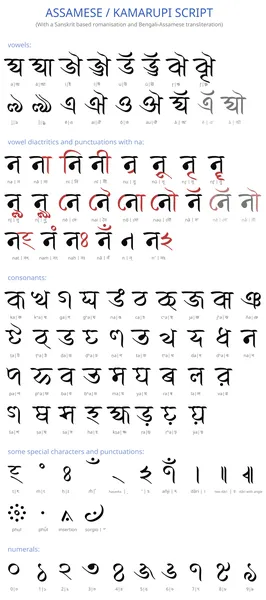
A traditional writing system of Assam that is now endangered. The Assamese script or Kamarupi script refers to the traditional writing system derived from Brahmi that developed as a distinct paleographic tradition in the Brahmaputra valley from the 5th century until the mid-20th century. The Assamese script first took its form in the 13th century and continued until the mid-20th century. Its earliest predecessor in Assam, the Ancient Kamarupi script, evolved through Gupta and Northern Indian script varieties, maintaining a cultural individuality that branched off from the common Eastern Indian script-group at a stage distinct from its relatives, such as Bengali or Maithili. Before the 20th century, the script was characterised by a variety of styles—specifically Gorgoya, Bamunia, and Kaitheli—used for royal chronicles, administrative charters, and liturgical manuscripts. The Assamese script is paleographically distinct from the modern Assamese alphabet, which is the standardized version based on the Bengali script, used today. The modern alphabet is characterised by a significant shift that occurred in the mid-19th century when the Assamese script was replaced by the Bengali script types for the technical convenience of the printing press. The original Assamese script possessed unique conjunct forms and structural attributes that make older manuscripts largely unintelligible to modern readers trained only in the current standardized Bengali-based alphabet.
Also on this shelf
Frank Mayborn.
Felicia Rice.
See also
- ▸Bengali Muslims
- ▸Arab-Norman Palermo and the Cathedral Churches of Cefalù and Monreale
- ▸Balinese language
Text from Wikipedia; plate via Wikimedia Commons. Text CC BY-SA 4.0; plate freely licensed (see Commons). Source record. Images and catalogue data are reproduced from open-access collections.