Writing and Printing
Cippi of Melqart
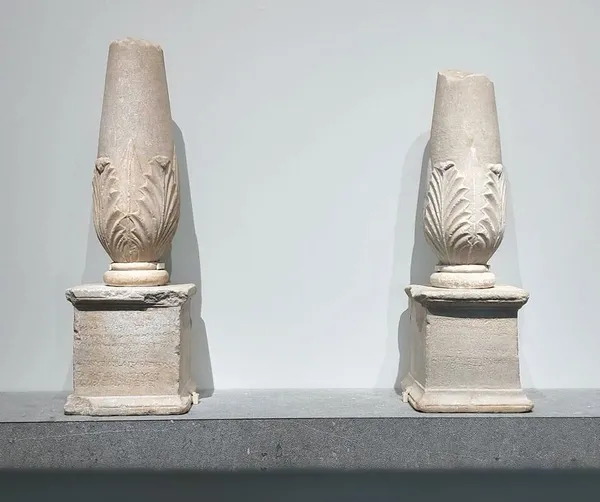
The Cippi of Melqart are a pair of Phoenician marble cippi that were unearthed in Malta under undocumented circumstances and dated to the 2nd century BC. These are votive offerings to the god Melqart, and are inscribed in two languages, Ancient Greek and Phoenician, and in the two corresponding scripts, the Greek and the Phoenician alphabet. They were discovered in the late 17th century, and the identification of their inscription in a letter dated 1694 made them the first Phoenician writing to be identified and published in modern times. Because they present essentially the same text (with some minor differences), the cippi provided the key to the modern understanding of the Phoenician language. In 1758, the French scholar Jean-Jacques Barthélémy relied on their inscription, which used 17 of the 22 letters of the Phoenician alphabet, to decipher the unknown language. The tradition that the cippi were found in Marsaxlokk was only inferred by their dedication to Heracles, whose temple in Malta had long been identified with the remains at Tas-Silġ. The Grand Master of the Order of the Knights Hospitaller, Fra Emmanuel de Rohan-Polduc, presented one of the cippi to the Académie des Inscriptions et Belles-Lettres in 1782. The inscription is known as KAI 47.
Also on this shelf
Biopython.
History of the Middle East.
See also
Uncatalogued shelfText from Wikipedia; plate via Wikimedia Commons. Text CC BY-SA 4.0; plate freely licensed (see Commons). Source record. Images and catalogue data are reproduced from open-access collections.