Writing and Printing
History of Alabama
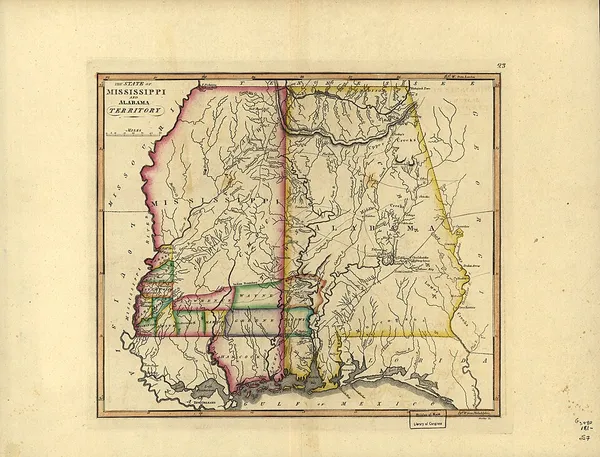
The history of the is now Alabama stems back thousands of years ago when it was inhabited by indigenous peoples. The Woodland period spanned from around 1000 BC to 1000 AD and was marked by the development of the Eastern Agricultural Complex. This was followed by the Mississippian culture of Native Americans, which lasted to around the 1600 AD. The first Europeans to make contact with Alabama were the Spanish, with the first permanent European settlement being Mobile, established by the French in 1702. After being a part of the Mississippi Territory (1798–1817) and then the Alabama Territory (1817–1819), Congress admitted Alabama as a state on December 14, 1819. After Indian Removal forcibly displaced most Southeast tribes to west of the Mississippi River to what was then called Indian Territory (now Oklahoma), European Americans arrived in large numbers, with some of them bringing or buying African Americans in the domestic slave trade. From the early to mid-19th century, the state's wealthy planter class considered slavery essential to their economy. As one of the largest slaveholding states, Alabama was among the first six states to secede from the Union. It declared its secession in January 1861, joining the Confederate States of America in February 1861. During the ensuing American Civil War (1861–1865) Alabama saw moderate levels of warfare and battles. Lincoln's Emancipation Proclamation freed all the enslaved people as soonas the U.S. arrived. Alabama transitioned into the Reconstruction era (1863–1877). During that time, its biracial government established the first public schools and welfare institutions in the state. For a half century following the Civil War, Alabama was mostly economically poor and heavily rural, with few industries within the state. Agriculture production, based primarily on cotton exports, was the main economic driver. Most farmers were tenants, sharecroppers or laborers who did not own land. Reconstruction ended when Democrats, calling themselves "Redeemers" regained control of the state legislature by both legal and extralegal means (including violence and harassment). In 1901, Southern Democrats in Alabama passed a state Constitution that effectively disfranchised most African Americans (who in 1900 comprised more than 45 percent of the state's population), as well as tens of thousands of Poor Whites in the state.
Also on this shelf
Balochi literature.
Accessible publishing.
See also
Uncatalogued shelfText from Wikipedia; plate via Wikimedia Commons. Text CC BY-SA 4.0; plate freely licensed (see Commons). Source record. Images and catalogue data are reproduced from open-access collections.