Writing and Printing
History of Boston
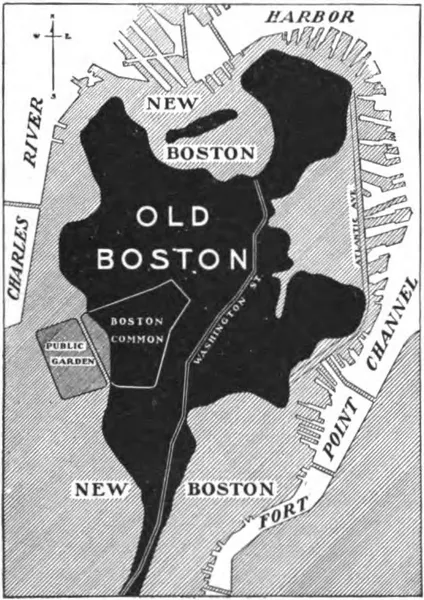
The written history of Boston begins with a letter drafted by the first European inhabitant of the Shawmut Peninsula, William Blaxton. This letter is dated September 7, 1630, and was addressed to the leader of the Puritan settlement of Charlestown, Isaac Johnson. The letter acknowledged the difficulty in finding potable water on that side of Back Bay. As a remedy, Blaxton advertised an excellent spring at the foot of what is now Beacon Hill and invited the Puritans to settle with him on Shawmut. Boston was named and officially incorporated on September 30, 1630 (Old Style). The city quickly became the political, commercial, financial, religious and educational center of Puritan New England and grew to play a central role in the history of the United States. When harsh British retaliation for the Boston Tea Party resulted in further violence by the colonists, the American Revolution erupted in Boston. Colonists besieged the British in the city, fighting a famous battle at Breed's Hill in Charlestown on June 17, 1775—a battle lost by the colonists but one that inflicted great damage on British forces. The colonists later won the Siege of Boston, forcing the British to evacuate the city on March 17, 1776. However, the combination of American and British blockades of the town and its port during the conflict seriously damaged the economy, leading to the exodus of two-thirds of its population in the 1770s. The city recovered after 1800 and re-established its role as the transportation hub for New England with a network of railroads. Beyond a renewed economic success the re-invigorated Boston became the intellectual, educational and medical center of the nation. Along with New York, Boston became the financial center of the United States in the 19th century, and the large amount of capital available there for investment was crucial in funding the expansion of a nationwide railroad. During and before the Civil War Boston was the launching pad and funding base for many of the country's anti-slavery activities. In the 19th century city politics and society became dominated by a financial elite known as the Boston Brahmins. This entrenched power base squared off against the political challenge of more recent Catholic immigrants for the rest of the 19th century.
Also on this shelf
History of the Greek alphabet.
British Library.
See also
Uncatalogued shelfText from Wikipedia; plate via Wikimedia Commons. Text CC BY-SA 4.0; plate freely licensed (see Commons). Source record. Images and catalogue data are reproduced from open-access collections.