Writing and Printing
Antanas Juška
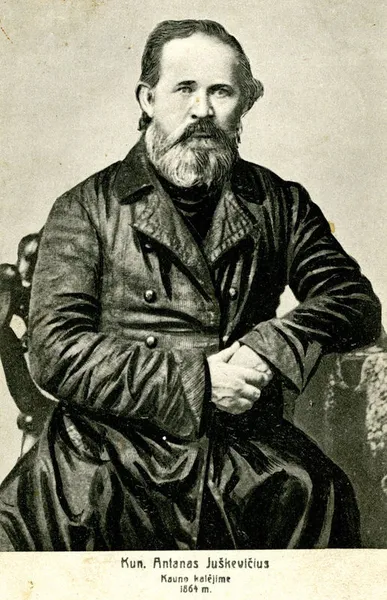
Antanas Juška (Polish: Antoni Juszkiewicz; 16 June 1819 – 1 November 1880) was a Lithuanian Roman Catholic priest known for his lifelong study of Lithuanian folk traditions. For about three decades, he observed the Lithuanian people, their traditions, and recorded their songs and vocabulary. Juška recorded about 7,000 Lithuanian folk songs, including about 2,000 songs with melodies, and wrote a 70,000-word Lithuanian–Polish dictionary. These works provide a wealth of information of the 19th-century Lithuanian life. His works were partially published with the help of his elder brother Jonas Juška. With the help of his brother Jonas, Juška attended Kražiai College and later transferred to the Vilnius Theological Seminary. He was ordained as a Catholic priest and later worked in various locations in Lithuania – Antazavė, Obeliai (1845), and Zarasai (1846–1849), Ukmergė (1849–1855), Pušalotas (1855–1862), Lyduvėnai (1862), Vilkija (1862–1864), Veliuona (1864–1871), Alsėdžiai (1871–1879). During the failed Uprising of 1863, he was arrested and imprisoned for nine months on suspicions of sympathizing with the rebels. He died in Kazan in 1880. Juška collected Lithuanian vocabulary and folk songs directly from the people. He wrote down the songs as they were performed – i.e. preserving nuances of the dialects. At about 7,000 songs, it was by far the largest collection of Lithuanian folk songs at the time (previously, a total of about 800 Lithuanian songs were published). However, only about 2,800 of them were published and the rest were lost during World War I. Despite the Lithuanian press ban, with the help of professor Jan Baudouin de Courtenay, three volumes of Lithuanian songs (a total of 1,586 songs) were published by the University of Kazan in 1880–1882 and a collection of 1,100 wedding songs was published by the Russian Academy of Sciences in 1883. Juška also wrote three dictionaries – 7,000-word Polish–Lithuanian (around 1854), 6,000-word Latvian–Lithuanian–Polish (1875), and 70,000-word Lithuanian–Polish dictionaries. The first two dictionaries were never published. His largest dictionary was prepared not based on words picked out from published texts but from the local vernacular.
Also on this shelf
Languages of China.
Alexander Cummings (territorial governor).
See also
Uncatalogued shelfText from Wikipedia; plate via Wikimedia Commons. Text CC BY-SA 4.0; plate freely licensed (see Commons). Source record. Images and catalogue data are reproduced from open-access collections.