Writing and Printing
Khirbet Qeiyafa ostracon
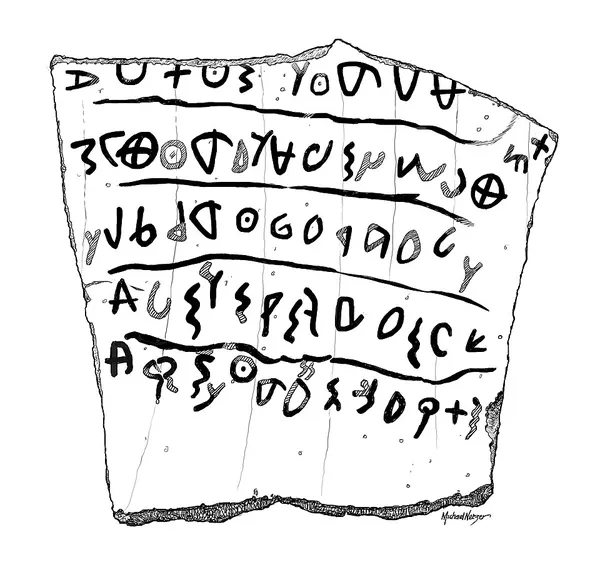
The Khirbet Qeiyafa ostracon is a 15-by-16.5-centimetre (5.9 in × 6.5 in) ostracon (a trapezoid-shaped potsherd) with five lines of text, discovered in Building II, Room B, in Area B of the excavations at Khirbet Qeiyafa in 2008 headed by Yosef Garfinkel and Michael G. Hasel. Hebrew University archaeologist Amihai Mazar said the inscription was the longest Proto-Canaanite text ever found. Carbon-14 dating of 4 olive pips found in the same context with the ostracon and pottery analysis offer a date of Iron Age IIA c. 3,000 years ago (late 11th/early 10th century BCE). In 2010, the ostracon was placed on display in the Iron Age gallery of the Israel Museum in Jerusalem.
Also on this shelf
Aimaq dialect.
Andrés Bonifacio.
See also
Uncatalogued shelfText from Wikipedia; plate via Wikimedia Commons. Text CC BY-SA 4.0; plate freely licensed (see Commons). Source record. Images and catalogue data are reproduced from open-access collections.