Writing and Printing
Argentine identity card
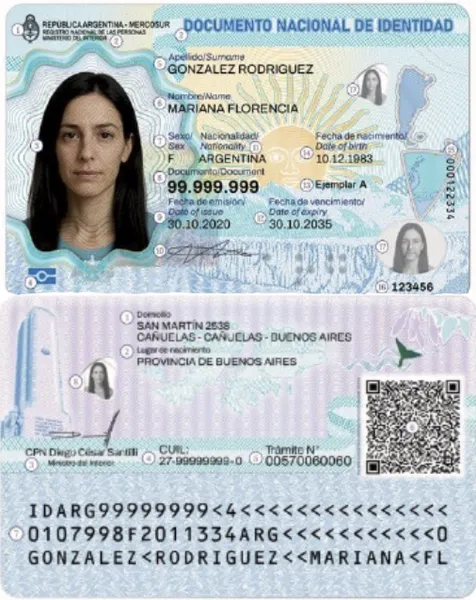
The Argentine identity card, Spanish: Documento Nacional de Identidad pronounced [dˌokumˈɛnto nˌaθjonˈal dˈe ˌiðentiðˈad] ) or DNI lit. 'National Identity Document'), is the main identity document for Argentine citizens, as well as temporary or permanent resident aliens (DNI Extranjero). It is issued at a person's birth, and must be updated at 5/8 and 14 years of age, and thereafter every 15 years. It takes the form of a card (DNI tarjeta), and is required for voting, payments (until 2024), military service inscriptions and formalities. They are issued by the National Registry of Persons (RENAPER), at a special plant in Parque Patricios, Buenos Aires City. The front side of the card states, in both English and Spanish, the name, sex, nationality, specimen issue, date of birth, date of issue, date of expiry, and transaction number along with the DNI number, portrait, and signature of the card's bearer. The back side of the card shows the address of the card's bearer (and it used to show with their right thumbprint along). Both back sides of the card shows a Data Matrix code, which later became a Qr code , and a machine-readable information. The unique DNI number is semi-perforated through the front-right side of the card. Also, biometric version includes braile support. The DNI is a valid international travel document to enter the member countries of Mercosur (Bolivia, Brazil, Paraguay and Uruguay) and countries associated to the bloc (Chile, Colombia, Ecuador and Peru; except Guyana, Suriname and Panama). On 29 January 2026, RENAPER issued Disposición 55/2026, approving a revised electronic DNI (or DNIe) design and replacing the relevant 2023 specifications. The new design entered into force on 1 February 2026. Existing DNI cards remain valid until their stated expiry date.
Also on this shelf
Gwoyeu Romatzyh.
Alfred Harmsworth, 1st Viscount Northcliffe.
See also
Uncatalogued shelfText from Wikipedia; plate via Wikimedia Commons. Text CC BY-SA 4.0; plate freely licensed (see Commons). Source record. Images and catalogue data are reproduced from open-access collections.