Writing and Printing
Columbus's letter on the first voyage
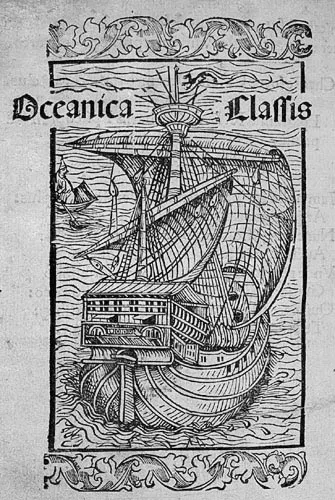
A letter written by Christopher Columbus on 15 February 1493, is the first known document announcing the completion of his first voyage across the Atlantic, which set out in 1492 and reached the Americas. The letter was ostensibly written by Columbus himself, aboard the caravel Niña, on the return leg of his voyage. A postscript was added upon his arrival in Lisbon on 4 March 1493, and it was probably from there that Columbus dispatched two copies of his letter to the Spanish court. The letter was instrumental in spreading the news throughout Europe about Columbus's voyage. Almost immediately after Columbus's arrival in Spain, printed versions of the letter began to appear. A Spanish version of the letter (presumably addressed to Luis de Santángel), was printed in Barcelona by early April 1493, and a Latin translation (addressed to Gabriel Sánchez) was published in Rome around a month later (ca. May 1493). The Latin version was swiftly disseminated and reprinted in many other locations—Basel, Paris, Antwerp, etc.—still within the first year of his arrival. In his letter, Christopher Columbus claimed to have discovered and taken possession of a series of islands on the edge of the Indian Ocean in Asia; Columbus was not aware that he had stumbled upon a new continent. He described the islands, particularly Hispaniola and Cuba, exaggerating their size and wealth, and suggested that mainland China probably lay nearby. He also gave a brief description of the Indigenous peoples (whom he called "Indians"), emphasizing their docility and amenability, and the prospects of their conversion to Catholicism. However, the letter also revealed local rumors about a fierce man-eating tribe of "monsters" in the area (probably Caribs), although Columbus himself disbelieved the stories, and dismissed them as a myth. The letter provides very few details of the oceanic voyage itself, and covers up the loss of the flagship of his fleet, the Santa María, by suggesting Columbus left it behind with some colonists, in a fort he erected at La Navidad in Hispaniola.
Also on this shelf
Creative Loafing.
James Mooney.
See also
Uncatalogued shelfText from Wikipedia; plate via Wikimedia Commons. Text CC BY-SA 4.0; plate freely licensed (see Commons). Source record. Images and catalogue data are reproduced from open-access collections.