Writing and Printing
Berber languages
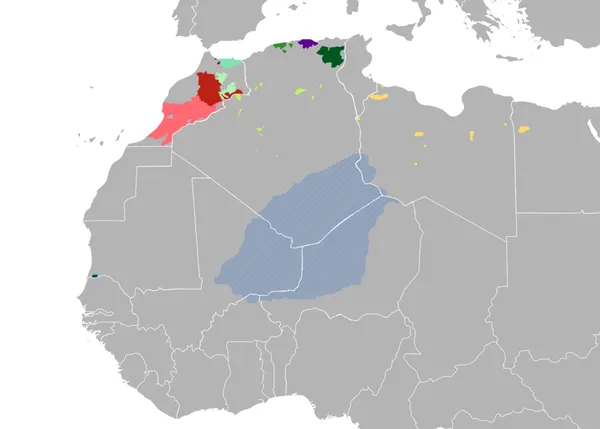
The Berber languages (also known as the Amazigh languages or Tamazight) are a branch of the Afroasiatic language family. They comprise a group of closely related languages spoken by Berber communities, who are indigenous to North Africa. Historically, they have been written with the ancient Libyco-Berber script, which now exists in the form of Tifinagh. Today, they may also be written in the Berber Latin alphabet or the Arabic script, with Latin being the most widespread. The Berber languages have a level of variety similar to the Romance languages, and with few exceptions form a dialect continuum. Regardless, they are frequently referred to as a single collective language, often as "Berber", "Tamazight", or "Amazigh". There is a debate as to how to best sub-categorize languages within the Berber branch. Berber languages typically follow verb–subject–object word order. Their phonological inventories are diverse. Outside of the various languages within it, there are currently two standardized national varities of Berber, Standard Algerian Amazigh, and Standard Moroccan Amazigh. Millions of people in Morocco and Algeria natively speak a Berber language, as do smaller populations of Libya, Tunisia, northern Mali, western and northern Niger, northern Burkina Faso and Mauritania and the Siwa Oasis of Egypt. There are also probably a few million speakers of Berber languages in Western Europe. Tashlhiyt, Kabyle, Central Atlas Tamazight, Tarifit, and Shawiya are some of the most commonly spoken Berber languages. Exact numbers are difficult to ascertain as there are few recent North African censuses that include questions on language use, and what censuses do exist tend to be biased. Since the 1950s, the Berber languages have been suppressed and suffered from low prestige in North Africa. Recognition of the Berber languages has grown in the 21st century, with Morocco and Algeria adding Tamazight as an official language to their constitutions in 2011 and 2016 respectively.
Also on this shelf
Codex Vindobonensis 751.
Kangxi Emperor.
See also
Uncatalogued shelfText from Wikipedia; plate via Wikimedia Commons. Text CC BY-SA 4.0; plate freely licensed (see Commons). Source record. Images and catalogue data are reproduced from open-access collections.