Writing and Printing
History of the Kingdom of Italy (1861–1946)
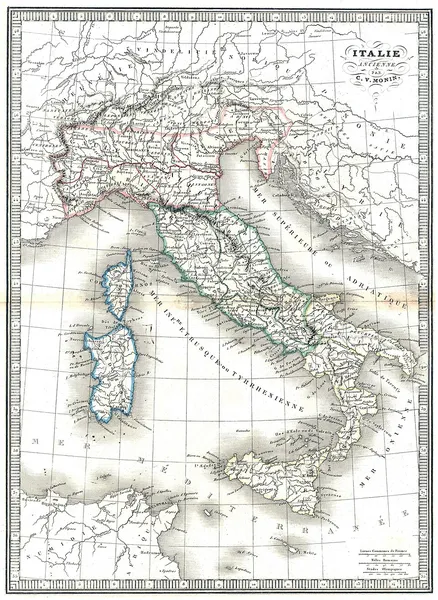
The Kingdom of Italy (Italian: Regno d'Italia) was a state that existed from 17 March 1861, when Victor Emmanuel II of Sardinia was proclaimed King of Italy, until 2 June 1946, when civil discontent led to an institutional referendum to abandon the monarchy and form the modern Italian Republic. The state resulted from a decades-long process, the Risorgimento, of consolidating the different states of the Italian Peninsula into a single state. That process was influenced by the Savoy-led Kingdom of Sardinia, which can be considered Italy's legal predecessor state. In 1866, Italy declared war on Austria in alliance with Prussia and received the region of Veneto following their victory. Italian troops entered Rome in 1870, ending more than one thousand years of Papal temporal power. Italy entered into a Triple Alliance with the German Empire and the Austro-Hungarian Empire in 1882, following strong disagreements with France about their respective colonial expansions. Although relations with Berlin became very friendly, the alliance with Vienna remained purely formal, due in part to Italy's desire to acquire Trentino and Trieste from Austria-Hungary. As a result, Italy accepted the British invitation to join the Allied Powers during World War I, as the western powers promised territorial compensation (at the expense of Austria-Hungary) for participation that was more generous than Vienna's offer in exchange for Italian neutrality. Victory in the war gave Italy a permanent seat in the Council of the League of Nations. In 1922, Benito Mussolini became prime minister of Italy, ushering in an era of National Fascist Party government known as "Fascist Italy". The Italian Fascists imposed totalitarian rule and crushed the political and intellectual opposition while promoting economic modernization, traditional social values, and a rapprochement with the Roman Catholic Church through the Lateran Treaties which created the Vatican City as a rump sovereign replacement for the Papal States. In the late 1930s, the Fascist government began a more aggressive foreign policy.
Also on this shelf
Art of Birmingham.
Constitutional Court of Albania.
See also
Uncatalogued shelfText from Wikipedia; plate via Wikimedia Commons. Text CC BY-SA 4.0; plate freely licensed (see Commons). Source record. Images and catalogue data are reproduced from open-access collections.