Writing and Printing
Keyboard layout
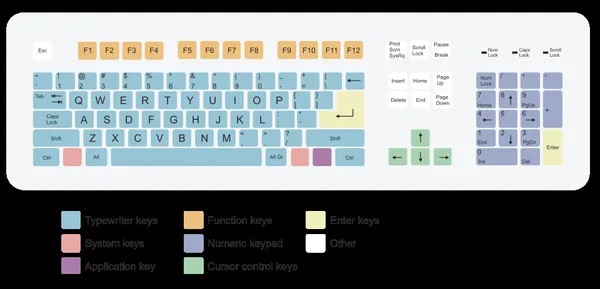
A keyboard layout is any specific physical, visual, or functional arrangement of key switches, legends, or key mapping (respectively) of a keyboard. Layouts are used on computer keyboards, for virtual keyboards (including mobile phones or other touchscreens), or other typographic input devices. Standard layouts vary depending on their intended writing system, language, and use case. Some hobbyists and designers create alternative layouts to better suit individual preferences or to extend functionality. Layouts can be described in several ways depending on form or function. A physical layout is the positioning of physical keys on a keyboard. The arrangement of keycap legends, such as markings or labels, is described as a visual layout. Keyboard mapping represents a functional layout, or the association of keys with their action when pressed. This is configured in software or firmware, and determines the action upon one or multiple key presses, regardless of key appearance. Modern computer keyboards are designed to send a scancode to the operating system (OS) when a key is pressed or released. This code reports only the key's row and column, not the specific character engraved on that key. The OS converts the scancode into a specific binary character code using a "scancode to character" conversion table, called the keyboard mapping table. This means that a physical keyboard may be dynamically mapped to any layout without switching hardware components—merely by changing the software that interprets the keystrokes. Often, a user can change keyboard mapping in system settings. In addition, software may be available to modify or extend keyboard functionality. Thus the symbol shown on the physical key-top need not be the same as appears on the screen or goes into a document being typed. Most modern USB and wireless keyboards are plug-and-play, and communicate their (default) visual layout to the OS when connected. Some keyboards have firmware which can configure layouts, as well as customize lighting and other functions.
Also on this shelf
Abner Gaines House.
Greeks.
See also
Uncatalogued shelfText from Wikipedia; plate via Wikimedia Commons. Text CC BY-SA 4.0; plate freely licensed (see Commons). Source record. Images and catalogue data are reproduced from open-access collections.