Writing and Printing
Caesar cipher
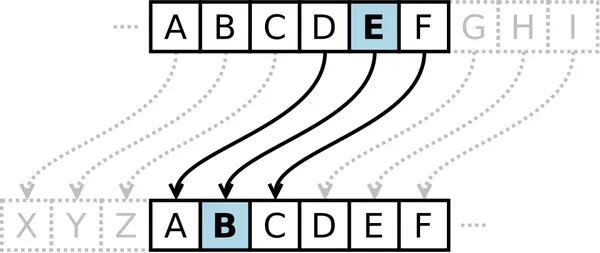
A Caesar cipher is one of the simplest and most widely known encryption techniques used in cryptography. It is a type of substitution cipher in which each letter in the plaintext is replaced by a letter some fixed number of positions along the alphabet. For example, with a left shift of 3, D would be replaced by A, E would become B, and so on. The method is named after Julius Caesar, who used it in his private correspondence. The encryption step performed by a Caesar cipher is often incorporated as part of more complex schemes, such as the Vigenère cipher, and still has modern application in the ROT13 system. As with all single-alphabet substitution ciphers, the Caesar cipher is easily broken and in modern practice offers essentially no communications security.
Also on this shelf
History of Miami.
Al-Karmil (newspaper).
See also
Uncatalogued shelfText from Wikipedia; plate via Wikimedia Commons. Text CC BY-SA 4.0; plate freely licensed (see Commons). Source record. Images and catalogue data are reproduced from open-access collections.