Writing and Printing
Aramaic alphabet
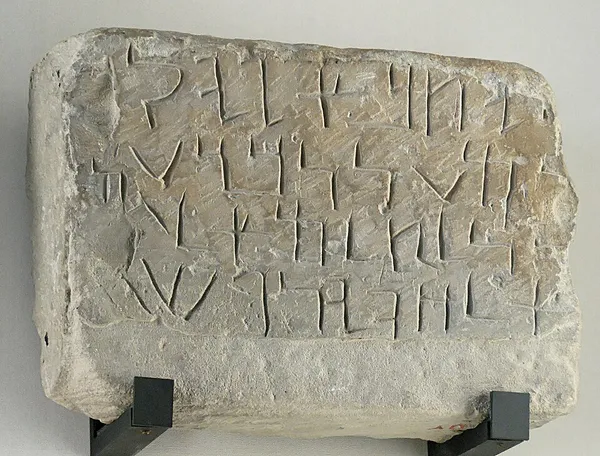
The ancient Aramaic alphabet was used to write the Aramaic languages spoken by ancient Aramean pre-Christian peoples throughout the Fertile Crescent. It was also adopted by other peoples as their own alphabet when empires and their subjects underwent linguistic Aramaization during a language shift for governing purposes — a precursor to Arabization centuries later — including among the Assyrians and Babylonians who permanently replaced their Akkadian language and its cuneiform script with Aramaic and its script, and among Jews (but not Samaritans) who adopted the Aramaic language as their vernacular and started using the Aramaic alphabet, which they call "Ktav Ashuri", even for writing Hebrew, displacing the former Paleo-Hebrew alphabet. The modern Hebrew alphabet derives from the Aramaic alphabet, in contrast to the modern Samaritan alphabet, which derives from Paleo-Hebrew. The letters in the Aramaic alphabet all represent consonants, some of which are also used as matres lectionis to indicate long vowels. Writing systems, like the Aramaic, that indicate consonants but do not indicate most vowels other than by means of matres lectionis or added diacritical signs, have been called abjads by Peter T. Daniels to distinguish them from alphabets such as the Greek alphabet, that represent vowels more systematically. The term was coined to avoid the notion that a writing system that represents sounds must be either a syllabary or an alphabet, which would imply that a system like Aramaic must be either a syllabary, as argued by Ignace Gelb, or an incomplete or deficient alphabet, as most other writers had said before Daniels. Daniels put forward that this is a different type of writing system, intermediate between syllabaries and 'full' alphabets. The Aramaic alphabet is historically significant since virtually all modern Middle Eastern writing systems can be traced back to it. That is primarily due to the widespread usage of the Aramaic language after it was adopted as both a lingua franca and the official language of the Neo-Assyrian Empire and Neo-Babylonian Empire, and their successor, the Achaemenid Empire. Among the descendant scripts in modern use, the Jewish Hebrew alphabet bears the closest relation to the Imperial Aramaic script of the 5th century BC, with an identical letter inventory and, for the most part, nearly identical letter shapes.
Also on this shelf
El (Cyrillic).
Dotless I.
See also
Uncatalogued shelfText from Wikipedia; plate via Wikimedia Commons. Text CC BY-SA 4.0; plate freely licensed (see Commons). Source record. Images and catalogue data are reproduced from open-access collections.