Writing and Printing
Georgians
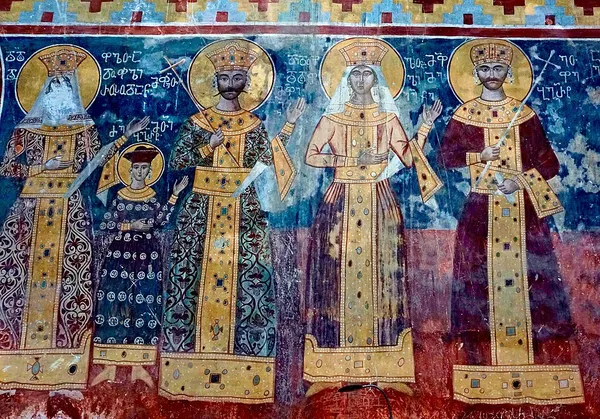
The Georgians, or Kartvelians (; Georgian: ქართველები, romanized: kartvelebi, pronounced [kʰaɾtʰʷelebi]), are a nation and Caucasian ethnic group native to present-day Georgia and surrounding areas historically associated with the Georgian kingdoms. Significant Georgian diaspora communities are also present throughout Russia, Turkey, Greece, Iran, Ukraine, the United States, and the European Union. Georgians are ethno-linguistically separate from all of their neighboring nations and primarily speak Georgian, a Kartvelian language with no known relation to any other language family in the world. Georgians arose from Colchian and Iberian civilizations of classical antiquity; Colchis was interconnected with the Hellenic world, whereas Iberia was influenced by the Achaemenid Empire until Alexander the Great conquered it. In the early 4th century, the Georgians became one of the first to embrace Christianity. The vast majority of Georgians are Orthodox Christians, with most following their national Georgian Orthodox Church; there are also some historically Catholic and Muslim communities, as well as a significant number of irreligious Georgians. Located in the Caucasus, on the continental crossroads of Europe and Asia, the High Middle Ages saw Georgian people form a unified Kingdom of Georgia in 1008 AD, later inaugurating the Georgian Golden Age. This lasted until the kingdom was weakened and later disintegrated as the result of the 13th–15th-century invasions of the Mongols and Timur, the Black Death, the Fall of Constantinople, as well as internal divisions following the death of George V the Brilliant in 1346, the last of the great kings of Georgia. Thereafter and throughout the early modern period, Georgians became politically fractured and were locked in conflict with much larger Muslim empires to its south, like the Ottoman Empire and successive dynasties of Iran. Georgians started looking for allies and found the Russians on the political horizon as a possible replacement for the lost Byzantine Empire "for the sake of the Christian faith". The Georgian kings and Russian tsars exchanged no less than 17 embassies, culminating in 1783 when Heraclius II of the eastern Georgian kingdom of Kartli-Kakheti forged an alliance with the Russian Empire.
Also on this shelf
Dze.
Filial piety.
See also
Uncatalogued shelfText from Wikipedia; plate via Wikimedia Commons. Text CC BY-SA 4.0; plate freely licensed (see Commons). Source record. Images and catalogue data are reproduced from open-access collections.