Writing and Printing
Carpentras Stele
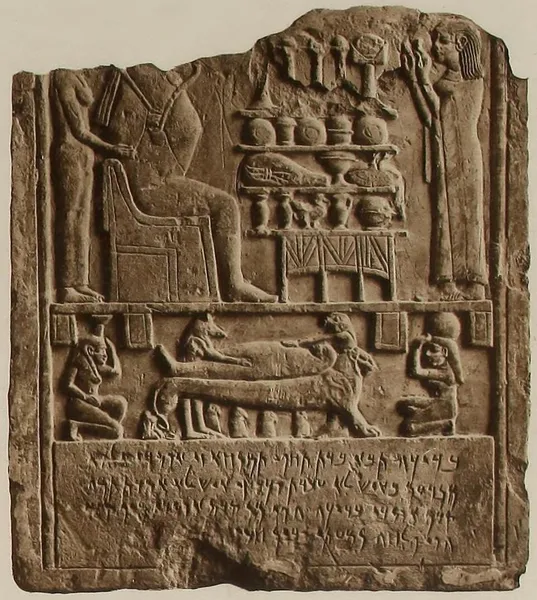
The Carpentras Stele is an Egyptian stele now in Carpentras in southern France. It is the first inscription written in the Phoenician alphabet to have been published, and was identified a century later as Aramaic. It is housed in the Bibliothèque Inguimbertine, in a "dark corner" on the first floor. Older Aramaic texts have been found dating from as early as the 9th century BC, but the Carpentras Stele is the first Aramaic text to have been published in modern times. It is known as KAI 269, CIS II 141 and TAD C20.5. It is a funerary dedication to an unknown lady called Taba; the first line of the image depicts her standing before the god of the underworld with her arms raised and the second, her lying down, dead, being prepared for burial. The textual inscription is typical of Egyptian funerary tablets in that she is described as having done nothing bad in her life, and wishes her well in the presence of Osiris. A long-running scholarly debate has focused on the language of the inscription, and whether it was written as prose or poetry. It was the first Northwest Semitic (i.e. Canaanite or Aramaic) inscription published anywhere in modern times (the Cippi of Melqart inscriptions, reported ten years earlier in 1694, were not published in full at that time). It was considered to be Phoenician text at the time of its discovery. Scholars later argued that the inscription was "Aramaic" or "Chaldean". Since the early 19th century the language of the inscription has been considered to be Aramaic. It was first translated in full by Jean-Jacques Barthélemy in the 1760s, and then by Oluf Gerhard Tychsen in 1802; the two translations were subsequently compared and critiqued by Ulrich Friedrich Kopp in 1821, who was in turn quoted by Wilhelm Gesenius in his widely published Scripturae Linguaeque Phoeniciae. Kopp criticised Barthélemy and other scholars who had characterized the inscription and some coins as Phoenician, with "everything left to the Phoenicians and nothing to the Arameans, as if they could not have written at all". Kopp noted that some of the words on the stele corresponded to the Aramaic in the Book of Daniel, and in the Book of Ruth.
Also on this shelf
Incung script.
History of Tonga.
See also
Uncatalogued shelfText from Wikipedia; plate via Wikimedia Commons. Text CC BY-SA 4.0; plate freely licensed (see Commons). Source record. Images and catalogue data are reproduced from open-access collections.