Writing and Printing
Horizontal and vertical writing in East Asian scripts
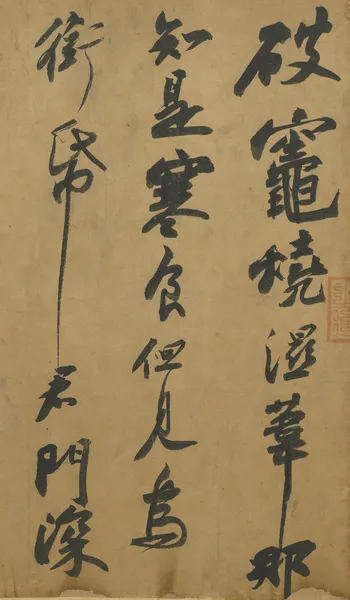
Many East Asian scripts can be written horizontally or vertically. Chinese characters, Korean hangul, and Japanese kana may be oriented along either axis, as they consist mainly of disconnected logographic or syllabic units, each occupying a square block of space, thus allowing for flexibility for which direction texts can be written, be it horizontally from left to right, horizontally from right to left, vertically from top to bottom, or even vertically from bottom to top. Traditionally, written Chinese, Vietnamese, Korean, and Japanese are written vertically in columns going from top to bottom and ordered from right to left, with each new column starting to the left of the preceding one. The stroke order and stroke direction of Chinese characters, Vietnamese chữ Nôm, Korean hangul, and kana all facilitate writing in this manner. In addition, writing in vertical columns from right to left facilitated writing with a brush in the right hand while continually unrolling the sheet of paper or scroll with the left. Since the nineteenth century, it has become increasingly common for these languages to be written horizontally, from left to right, with successive rows going from top to bottom, under the influence of European languages such as English, although vertical writing is still frequently used in Hong Kong, Japan, Macau, and Taiwan.
Also on this shelf
Cecil Whig.
Kurukh Banna.
See also
Uncatalogued shelfText from Wikipedia; plate via Wikimedia Commons. Text CC BY-SA 4.0; plate freely licensed (see Commons). Source record. Images and catalogue data are reproduced from open-access collections.