Writing and Printing
Byblos syllabary
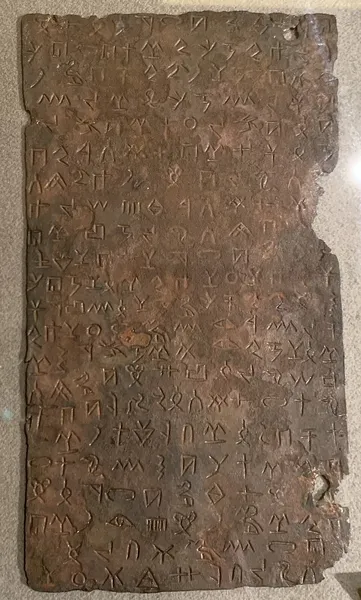
The Byblos script, also known as the Byblos syllabary, Pseudo-hieroglyphic script, Proto-Byblian, Proto-Byblic, or Byblic, is an undeciphered writing system, known from fourteen inscriptions found in Byblos, a coastal city in Lebanon. The inscriptions are engraved on bronze plates and spatulas, and carved in stone. They were excavated by Maurice Dunand, from 1928 to 1932, and published in 1945 in his monograph Byblia Grammata. The inscriptions are conventionally dated to the second millennium BC, probably between the 18th and 15th centuries BC. Examples of the script have also been discovered in Egypt, Italy, and Megiddo (Garbini, Colless).
Also on this shelf
Bhujimol script.
Conrad Black.
See also
Uncatalogued shelfText from Wikipedia; plate via Wikimedia Commons. Text CC BY-SA 4.0; plate freely licensed (see Commons). Source record. Images and catalogue data are reproduced from open-access collections.