Writing and Printing
Iñupiaq language
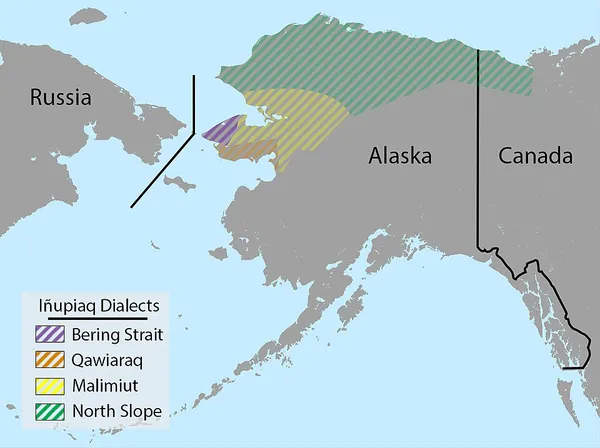
Iñupiaq or Inupiaq ( ih-NOO-pee-ak, Inupiaq: [iɲupiaq]), also known as Iñupiat, Inupiat ( ih-NOO-pee-at), Iñupiatun or Alaskan Inuit, is an Inuit language, or perhaps group of languages, spoken by the Iñupiat people in northern and northwestern Alaska, as well as a small adjacent part of the Northwest Territories of Canada. The Iñupiat language is a member of the Inuit–Yupik–Unangan language family, and is closely related and, to varying degrees, mutually intelligible with other Inuit languages of Canada and Greenland. There are roughly 2,000 speakers. Iñupiaq is considered to be a threatened language, with most speakers at or above the age of 40. Iñupiaq is an official language of the State of Alaska, along with several other indigenous languages. The major varieties of the Iñupiaq language are the North Slope Iñupiaq and Seward Peninsula Iñupiaq dialects. The Iñupiaq language has been in decline since contact with English in the late 19th century. American territorial acquisition and the legacy of boarding schools have created a situation today where a small minority of Iñupiat speak the Iñupiaq language. There is, however, revitalization work underway today in several communities.
Also on this shelf
Abuzar Aydamirov.
American urban history.
See also
Uncatalogued shelfText from Wikipedia; plate via Wikimedia Commons. Text CC BY-SA 4.0; plate freely licensed (see Commons). Source record. Images and catalogue data are reproduced from open-access collections.