Writing and Printing
Frisii
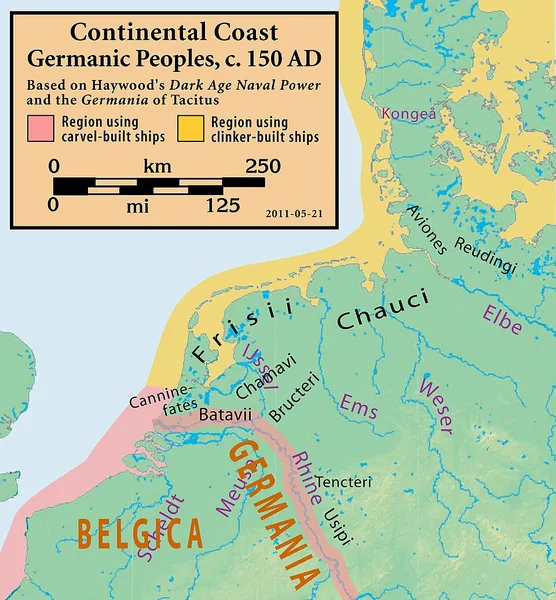
The Frisii were the inhabitants of what are now the coastal regions north of the Rhine delta during the Roman Empire, corresponding to what is now the coastal Netherlands north of the Rhine and approximately the provinces of North Holland, Friesland and Groningen. They are known from Roman records between about 12 BC and 297 AD, and after this the name of the Frisii disappeared from records for approximately 300 years. The details of the connection between them and the later medieval Frisians is uncertain because there is a long gap in the records, and evidence of a major decrease and change in the population during that period. During the 1st century BC, Romans took control of the Rhine delta and made a treaty with the Frisii to the north of the river which required them to supply cattle hides, but they managed to maintain some level of independence and they fought in several major revolts against the Romans in the first century AD. Frisii were enlisted in the Roman military, and the elite German bodyguard of the emperors. During the Crisis of the Third Century, the Roman Empire lost control of the Rhine delta and peoples from north of the Rhine including Frisii and Chamavi settled south of the Rhine. The military Tetrarchy emperors pacified the region by moving large parts of the population out of the region, as servile laeti or soldiers in the Roman military. The Latin Panegyrics report them being used as farm labourers in Gaul. At this time it appears that at least some Frisii were, like neighbouring peoples, categorized by Romans as Franks, and administratively the people removed from Batavia itself at this time were apparently placed into military units and laeti prefectures named after the Batavi, who had originally lived in that district. After the third century, written records ceased to mention the Frisii for several centuries during the so-called Migration Period. The new terms Frank and Saxon were used to refer to the peoples who often raided from north of the Rhine,. The two terms covered several peoples and were apparently not mutually exclusive at first. Archaeological records show that in the coastal region where the Frisii had lived there was significant population decline and social disruption, possibly connected to frequent flooding caused by sea level rise.
Also on this shelf
Clandestine Lithuanian schools.
Cursive.
See also
Uncatalogued shelfText from Wikipedia; plate via Wikimedia Commons. Text CC BY-SA 4.0; plate freely licensed (see Commons). Source record. Images and catalogue data are reproduced from open-access collections.