Writing and Printing
Historiography in the Middle Ages
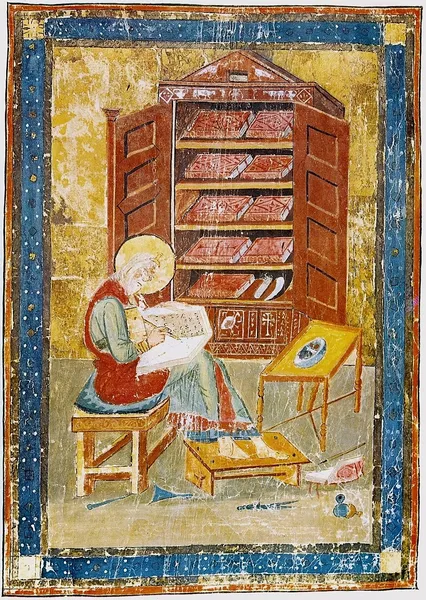
Historiography in the Middle Ages (in Russian: Средневековая историография, in German: Mittelalterliche Geschichtsschreibung, in French: Historiographie médiévale) refers to the deliberate preservation of the memory of the past in the historical writings of Western European authors from the 4th to the 15th centuries. As a continuation of Ancient historiography, it diverged by organizing events in strict chronological order rather than by cause-and-effect relationships and tended to be poorly localized geographically. History was not recognized as an independent discipline during the Middle Ages, and there was no professional historian. Nonetheless, authors understood the distinctiveness of the historical genre. Historical writing was primarily the work of the clergy, though it was also undertaken by statesmen, troubadours, minstrels, and members of the bourgeoisie. Most texts were composed in Latin, with vernacular works appearing only from the High Middle Ages onward. While retaining the rhetorical methods inherited from antiquity, medieval historiography was deeply shaped by Christian concepts, primarily universalism and eschatology. Almost all medieval historians adopted a universalist worldview, seeing history as the unfolding of God's will. As R. Collingwood noted, “history, as the will of God, predetermines itself... even those who think they oppose it actually contribute to its fulfillment. Medieval historians typically presented past and contemporary events in chronological order, a method that led to the notion of historical development through stages. One early scheme, by Hippolytus of Rome and Julius Africanus, fused the classical idea of the four ages (Golden, Silver, Bronze, Iron) with Christian providentialism, linking each era with a major empire: Chaldean, Persian, Macedonian, and Roman. A later influential model was proposed by Joachim of Fiore in the 12th century, who divided history into three epochs: the Age of the Father (pre-Christian), the Age of the Son (Christian era), and the anticipated Age of the Holy Spirit. Revelation served as the interpretive key to understanding divine acts in history. However, while it revealed God’s plans for the future, the historian's task remained confined to interpreting the past.
Also on this shelf
Harper (publisher).
A with diaeresis (Cyrillic).
See also
Uncatalogued shelfText from Wikipedia; plate via Wikimedia Commons. Text CC BY-SA 4.0; plate freely licensed (see Commons). Source record. Images and catalogue data are reproduced from open-access collections.