Writing and Printing
History of Madagascar
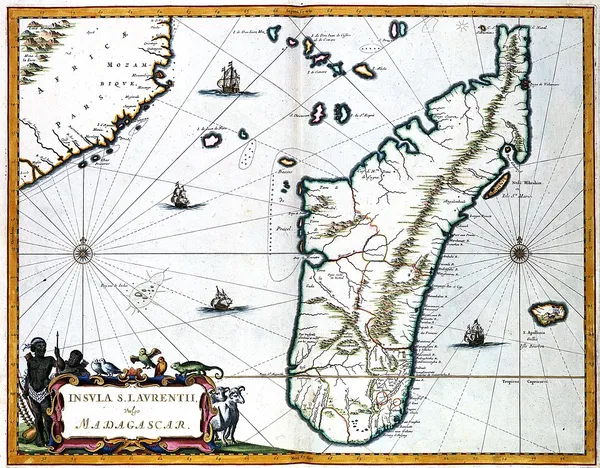
The history of Madagascar started from the ancient supercontinent of Pangaea, containing amongst others the African continent and the Indian subcontinent, and by the island's late colonization by human settlers from South Borneo, Indonesia and from East Africa. These two factors facilitated the evolution and survival of thousands of endemic plant and animal species, some of which have gone extinct or are currently threatened with extinction. Trade in the Indian Ocean at the time of first colonization of Madagascar was dominated by Indonesian ships, probably of Borobudur ship and K'un-lun po types. Over two thousand years, the island has received waves of settlers of diverse origins, primarily Austronesian and Bantu. Centuries of intermarriages between both groups created the Malagasy people, who are roughly an equal mixture of both groups. They speak Malagasy, an Austronesian language with Bantu, French and Arabic influences. By the Middle Ages, over a dozen distinct ethnic identities had emerged on the island, typified by rule under a local chieftain. Some communities, such as the Sakalava, Merina and Betsimisaraka, were unified by leaders who established kingdoms, which gained wealth and power through commerce with Europeans and Arabs. Between the 16th and 18th centuries, pirate activity in the coastal areas of Madagascar was common. The Sakalava and Merina kingdoms in particular exploited European trade to strengthen the power of their kingdoms, trading Malagasy slaves for European firearms and other goods. Beginning in the early 19th century, the British and French competed for influence in Madagascar. By the turn of the 19th century, King Andrianampoinimerina had reunited the highly populous Kingdom of Imerina in the central highlands, with its capital at Antananarivo. His son Radama I the Great expanded its authority to the island's other polities and was the first Malagasy sovereign to be recognized by foreign states as the ruler of the greater Merina Kingdom. During the rule of Queen Ranavalona I (r. 1828–1861), the kingdom was further expanded to encompass most of the island. Madagascar's population is estimated to have declined by half from 5 million to 2.5 million between 1833 and 1839 from war, disease, slavery, and other violence.
Also on this shelf
Gagauz language.
Arbëreshë people.
See also
Uncatalogued shelfText from Wikipedia; plate via Wikimedia Commons. Text CC BY-SA 4.0; plate freely licensed (see Commons). Source record. Images and catalogue data are reproduced from open-access collections.