Writing and Printing
Greenlandic language
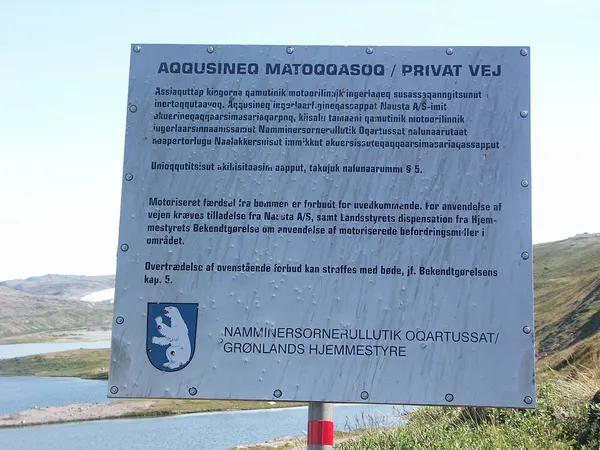
Greenlandic, also known by its endonym Kalaallisut (kalaallisut, [kalaːɬːisʉt]), is an Inuit language belonging to the Eskimoan branch of the Eskaleut language family. It is primarily spoken by the Greenlandic people native to Greenland, with about 57,000 native speakers as of 2025, making it the largest Eskaleut language by number of speakers. Written in the Latin script, it is the sole official language of Greenland, and a recognized minority language in Denmark. In June 2009, the government of Greenland, the Naalakkersuisut, made Greenlandic the sole official language of the autonomous territory, to strengthen it in the face of competition from the colonial language, Danish. Greenlandic is closely related to Canadian Inuit languages such as Inuktitut. The main variety is Kalaallisut, or West Greenlandic. The second variety is Tunumiit oraasiat, or East Greenlandic. The language of the Inughuit (Thule Inuit) of Greenland, Inuktun or Polar Inuit, is a recent arrival and a dialect of Inuktitut. Greenlandic is a polysynthetic language that allows the creation of long words by stringing together roots and suffixes. The language's morphosyntactic alignment is ergative, treating both the subject of an intransitive verb and the object of a transitive verb in one way, but the subject of a transitive verb in another. For example, "he plays the guitar" would be in the ergative case as a transitive agent, whereas "I bought a guitar" and "as the guitar plays" (the latter being the intransitive sense of the same verb "to play") would both be in the absolutive case. Nouns are inflected by one of eight cases and for possession. Verbs are inflected for one of eight moods and for the number and person of its subject and object. Both nouns and verbs have complex derivational morphology. The basic word order in transitive clauses is subject–object–verb. The subordination of clauses uses special subordinate moods. A so-called fourth-person category enables switch-reference between main clauses and subordinate clauses with different subjects. Greenlandic is notable for its lack of grammatical tense; temporal relations are expressed normally by context but also by the use of temporal particles such as "yesterday" or "now" or sometimes by the use of derivational suffixes or the combination of affixes with aspectual meanings with the semantic lexical aspect of different verbs.
Also on this shelf
Araea (letter).
Delhi Urdu Akhbar.
See also
Uncatalogued shelfText from Wikipedia; plate via Wikimedia Commons. Text CC BY-SA 4.0; plate freely licensed (see Commons). Source record. Images and catalogue data are reproduced from open-access collections.