Writing and Printing
Cypriot syllabary
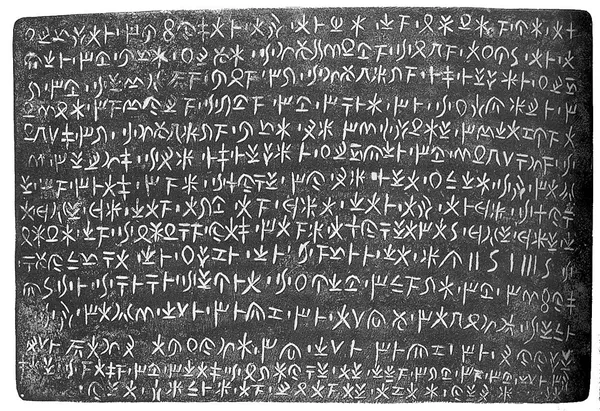
The Cypriot or Cypriote syllabary (also Classical Cypriot Syllabary, or Linear C) is a syllabic script used in Iron Age Cyprus, from about the 11th to the 4th centuries BCE, when it was replaced by the Greek alphabet. It has been suggested that the script remained in use as late as the 1st century BCE. A pioneer of that change was King Evagoras of Salamis. It is thought to be descended from the Cypro-Minoan syllabary, itself a variant or derivative of Linear A. Most texts using the script are in the Arcadocypriot dialect of Greek, but also one bilingual inscription, the Amathus bilingual, a Greek and Eteocypriot, was found in Amathus.
Also on this shelf
Frank Mayborn.
De Telegraaf.
See also
Uncatalogued shelfText from Wikipedia; plate via Wikimedia Commons. Text CC BY-SA 4.0; plate freely licensed (see Commons). Source record. Images and catalogue data are reproduced from open-access collections.