Writing and Printing
Chronogram
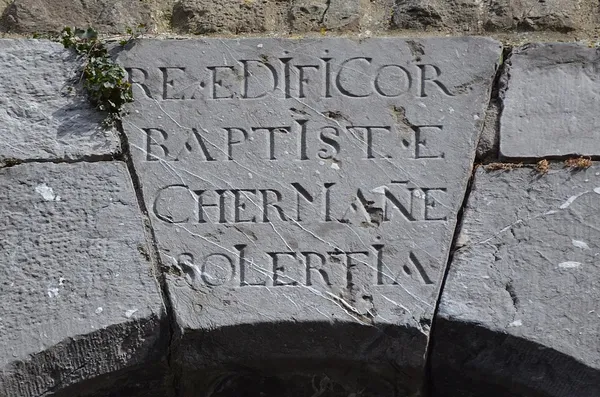
A chronogram is a sentence or inscription in which specific letters, interpreted as numerals (such as Roman numerals), stand for a particular date when rearranged. The word, meaning "time writing", derives from the Greek words chronos (χρόνος "time") and gramma (γράμμα, "letter"). In the pure chronogram, each word contains a numeral; the natural chronogram shows all numerals in the correct numerical order, e.g. AMORE MATVRITAS = MMVI = 2006. Chronograms in versification are referred to as chronosticha if they are written in hexameter and chronodisticha if they are written in distich. In the ancient Indonesian Hindu-Buddhist tradition, especially in ancient Java, chronograms were called chandrasengkala and usually used in inscriptions to signify a given year in the Saka calendar. Certain words were assigned their specific number, and poetic phrases were formed from these selected words to describe particular events that have their own numerical meanings. For example, the chandrasengkala "sirna ilang kertaning bumi" ("the wealth of earth disappeared and diminished") (sirna = 0, ilang = 0, kerta = 4, bumi = 1) corresponds to the year 1400 in the Saka calendar (1478 CE), the date of the fall of the Majapahit Empire.
Also on this shelf
Afrikaans.
Dirk Martens.
See also
Uncatalogued shelfText from Wikipedia; plate via Wikimedia Commons. Text CC BY-SA 4.0; plate freely licensed (see Commons). Source record. Images and catalogue data are reproduced from open-access collections.