Writing and Printing
Dysgraphia
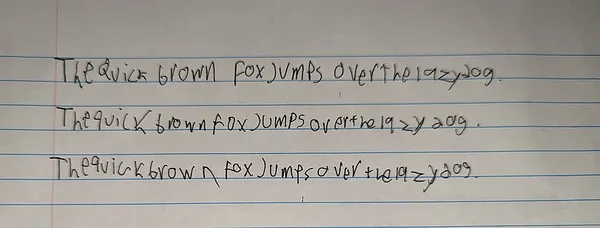
Dysgraphia is a neurological disorder and learning disability that concerns impairments in written expression, which affects the ability to write, primarily handwriting, but also coherence. It is a specific learning disability (SLD) as well as a transcription disability, meaning that it is a writing disorder associated with impaired handwriting, orthographic coding and finger sequencing (the movement of muscles required to write). It often overlaps with other learning disabilities and neurodevelopmental disorders such as speech impairment, attention deficit hyperactivity disorder (ADHD) or developmental coordination disorder (DCD). Dysgraphia should be distinguished from agraphia (sometimes called acquired dysgraphia), which is an acquired loss of the ability to write resulting from brain injury, progressive illness, or a stroke.
Also on this shelf
DELO.
Jutes.
See also
Uncatalogued shelfText from Wikipedia; plate via Wikimedia Commons. Text CC BY-SA 4.0; plate freely licensed (see Commons). Source record. Images and catalogue data are reproduced from open-access collections.