Writing and Printing
Cherusci
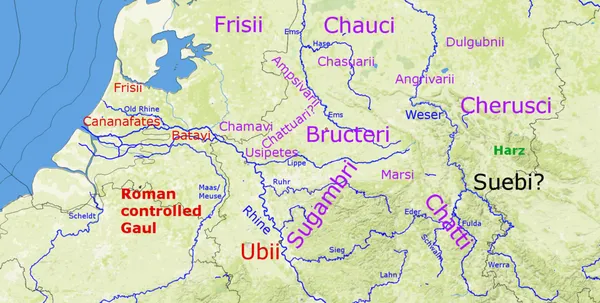
The Cherusci were a Germanic people who lived in what is now northern Germany during the first centuries BC and AD. Roman authors described them living in an area around the middle of the Weser River, to their west were peoples living near the Ems and Lippe rivers such as the Bructeri, Sicambri and Marsi, and in the west their territory stretched towards the Elbe and the Suebian peoples who lived there, including the Langobardi and Semnones. To their north, also on the Weser, were the Angrivarii, and to the southwest of the Cherusci were the Chatti. The Cherusci played a leading role in the Germanic revolt against the Roman empire which began in 9 AD, when a coalition led by the Cheruscan noble Arminius ambushed and destroyed three Roman legions led by Publius Quinctilius Varus, in an attack conventionally known as the Battle of the Teutoburg Forest. The revolt involved several neighbouring tribes, but Maroboduus, king of the Marcomanni, and the peoples within his sphere of power did not join the revolt. The Roman prince and military leader Germanicus led reprisal campaigns from 14 AD to 16 AD with mixed success, but he did not succeed to destroy the coalitions of Arminius or Maroboduus, or restore lasting Roman control. After this the Roman empire gave up its ambitions of largescale conquest and the creation of Roman provincial government in the region between the Rhine and Elbe. Instead however the empire continued to influence and intervene in the region. Before the revolt the Cherusci were allies of Rome. Some, including Arminius and his brother Flavus, served in the Roman army, and received Roman citizenship. Several Cheruscan nobles remained loyal to Rome or opposed Arminius at different times, and in various ways. They included his brother Flavus, who continued to serve in the Roman army, and his father-in-law Segestes, who warned Varus of the conspiracy. In 17 AD, after the withdrawal of Germanicus, another Cherusci faction led by the uncle of Arminius, Inguiomerus, defected to Maroboduus, king of the Marcomanni. Arminius was killed by relatives in AD 21 after being accused of seeking kingship. In 47 AD the Romans sent Italicus, the son of Flavus and the last known member of the Cheruscan royal family, to rule the tribe as king.
Also on this shelf
History of accounting.
Editorial.
See also
Uncatalogued shelfText from Wikipedia; plate via Wikimedia Commons. Text CC BY-SA 4.0; plate freely licensed (see Commons). Source record. Images and catalogue data are reproduced from open-access collections.