Writing and Printing
History of Detroit
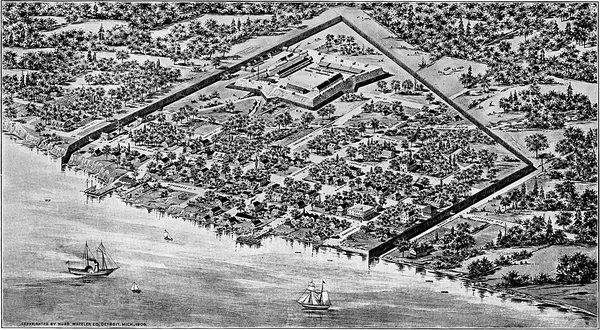
Detroit, the largest city in the state of Michigan, was settled in 1701 by French colonists. It is the first European settlement above tidewater in North America. Founded as a New France fur trading post, it began to expand during the 19th century with U.S. settlement around the Great Lakes. By 1920, based on the booming auto industry and immigration, it became a world-class industrial powerhouse and the fourth-largest city in the United States. It held that standing through the mid-20th century. The first Europeans to settle in Detroit were French country traders and colonists from Montreal and Quebec; they had to contend with the powerful Five Nations of the League of the Iroquois (Haudenosaunee), who took control of the southern shores of Lakes Erie and Huron through the Beaver Wars of the 17th century. Also present and powerful, but further to the north, were the Council of Three Fires (Anishinaabe). (in Anishinaabe: Niswi-mishkodewinan, also known as the People of the Three Fires; the Three Fires Confederacy; or the United Nations of Chippewa, Ottawa, and Potawatomi Indians) is a long-standing Anishinaabe alliance of the Ojibwe (or Chippewa), Odawa (or Ottawa), and Potawatomi North American Native tribes. The Three Fires Confederacy (Anishinaabe) were often supported by the French, while the so-called League of Iroquois, or Five Nations (Haudenosaunee) was supported by the English and Dutch. Immigration grew initially for the lucrative inland and Great Lakes connected fur trade, based on continuing relations with influential Native American chiefs and interpreters. The Crown's administration of New France offered free land to colonists to attract families to the region of Detroit. The population grew steadily, but more slowly than in the English private venture-funded Thirteen Colonies based on the Atlantic coast. The French had a smaller population base and attracted fewer families. During the French and Indian War (1756–1763), the French reinforced and improved Fort Detroit (which had been constructed in 1701) along the Detroit River between 1758 and 1760. It was subject to repeated attacks by British and colonial forces combined with their Indian allies. Fort Detroit was surrendered to the British on November 29, 1760, after the fall of Quebec.
Also on this shelf
Aušra (Vilnius newspaper).
Hamza.
See also
Uncatalogued shelfText from Wikipedia; plate via Wikimedia Commons. Text CC BY-SA 4.0; plate freely licensed (see Commons). Source record. Images and catalogue data are reproduced from open-access collections.