Writing and Printing
Albanian language
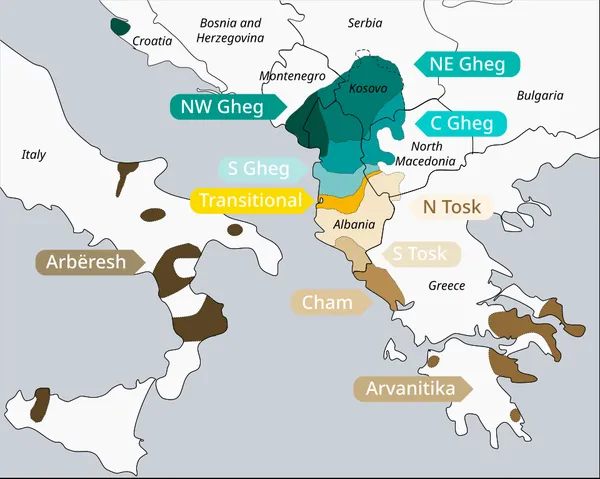
Albanian (endonym: shqip [ʃcip] , gjuha shqipe [ˈɟuha ˈʃcipɛ] , or arbërisht [aɾbəˈɾiʃt]) is an Indo-European language and the only surviving representative of the Albanic branch, which belongs to the Paleo-Balkan group. It is the native language of the Albanian people. Standard Albanian is the official language of Albania and Kosovo, and a co-official language in North Macedonia and Montenegro, where it is the primary language of significant Albanian minority communities. Albanian is recognized as a minority language in Italy, Croatia, Romania, and Serbia. It is also spoken by long-established communities in Greece, and by the Albanian diaspora, which is generally concentrated in the Americas, Europe, and Oceania. Albanian is estimated to have as many as 7.5 million native speakers. Albanian and other Paleo-Balkan languages had their formative core in the Balkans after the Indo-European migrations in the region. Albanian in antiquity is often thought to have been an Illyrian language for obvious geographic and historical reasons, or otherwise an unmentioned Balkan Indo-European language that was closely related to Illyrian and Messapic. The Indo-European subfamily that gave rise to Albanian is called Albanoid in reference to a specific ethnolinguistically pertinent and historically compact language group. Whether descendants or sisters of what was called 'Illyrian' by classical sources, Albanian and Messapic, on the basis of shared features and innovations, are grouped together in a common branch in the current phylogenetic classification of the Indo-European language family. The first written mention of the Albanian language was in 1284 in a witness testimony from the Republic of Ragusa, while a letter written by Dominican Friar Gulielmus Adea in 1332 mentions the Albanians using the Latin alphabet in their writings. The oldest surviving attestation of modern Albanian is from 1462. The two main Albanian dialect groups (or varieties), Gheg and Tosk, are primarily distinguished by phonological differences and are mutually intelligible in their standard varieties, with Gheg spoken to the north and Tosk spoken to the south of the Shkumbin river.
Also on this shelf
Le Travailleur (newspaper).
Kaifeng Jews.
See also
Uncatalogued shelfText from Wikipedia; plate via Wikimedia Commons. Text CC BY-SA 4.0; plate freely licensed (see Commons). Source record. Images and catalogue data are reproduced from open-access collections.