Writing and Printing
Aegean Sea
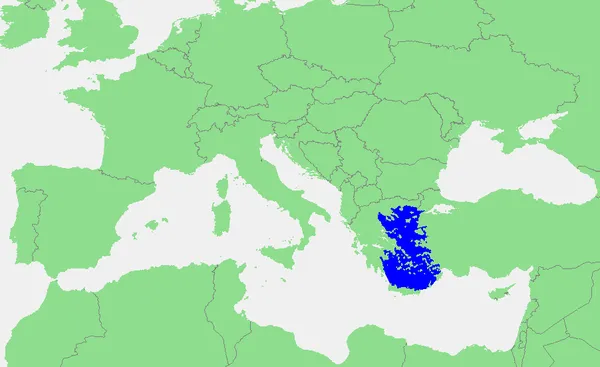
The Aegean Sea is an elongated embayment of the Mediterranean Sea between Europe and Asia. It is located between the Balkans and Anatolia, and covers an area of some 215,000 km2 (83,000 sq mi). In the north, the Aegean is connected to the Marmara Sea, which in turn connects to the Black Sea, by the straits of the Dardanelles and the Bosphorus, respectively. The Aegean Islands are located within the sea and some bound it on its southern periphery, including Crete and Rhodes. The sea reaches a maximum depth of 2,639 m (8,658 ft) to the west of Karpathos. The Thracian Sea and the Sea of Crete are main subdivisions of the Aegean Sea. The Aegean Islands can be divided into several island groups, including the Dodecanese, the Cyclades, the Sporades, the Saronic islands and the North Aegean Islands, as well as Crete and its surrounding islands. The Dodecanese, located to the southeast, includes the islands of Rhodes, Kos, and Patmos; the islands of Delos and Naxos are within the Cyclades to the south of the sea. Lesbos is part of the North Aegean Islands. Euboea, the second-largest island in Greece, is located in the Aegean, despite being administered as part of Central Greece. Nine out of twelve of the Administrative regions of Greece border the sea, along with the Turkish provinces of Edirne, Çanakkale, Balıkesir, İzmir, Aydın and Muğla to the east of the sea. Various Turkish islands in the sea are Imbros, Tenedos, Cunda Island, and the Foça Islands. The Aegean Sea has been historically important, especially regarding the civilization of Ancient Greece, which inhabited the area around the coast of the Aegean and the Aegean islands. The Aegean islands facilitated contact between the people of the area and between Europe and Asia. Along with the Greeks, Thracians lived along the northern coasts. The Romans conquered the area under the Roman Empire, and later the Byzantine Empire held it against advances by the First Bulgarian Empire. The Fourth Crusade weakened Byzantine control of the area, and it was eventually conquered by the Ottoman Empire, with the exception of Crete, which was a Venetian colony until 1669. The Greek War of Independence allowed a Greek state on the coast of the Aegean from 1829 onwards.
Also on this shelf
History of Lithuania.
English-language spelling reform.
See also
Uncatalogued shelfText from Wikipedia; plate via Wikimedia Commons. Text CC BY-SA 4.0; plate freely licensed (see Commons). Source record. Images and catalogue data are reproduced from open-access collections.