Writing and Printing
History of the Byzantine Empire
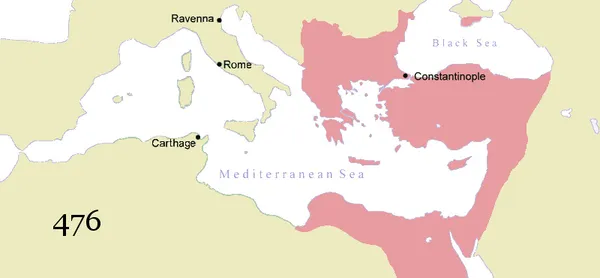
The Byzantine Empire's history is generally periodised from late antiquity until the Fall of Constantinople in 1453 AD. From the 3rd to 6th centuries, the Greek East and Latin West of the Roman Empire gradually diverged, marked by Diocletian's (r. 284–305) formal partition of its administration in 285, the establishment of an eastern capital in Constantinople by Constantine I in 330, and the adoption of Christianity as the state religion under Theodosius I (r. 379–395), with others such as Roman polytheism being proscribed. Although the Western half of the Roman Empire had collapsed in 476, the Eastern half remained stable and emerged as one of the most powerful states in Europe, a title it held for most of its existence. Under the reign of Heraclius (r. 610–641), the Empire's military and administration were restructured and adopted Greek for official use instead of Latin. While there was an unbroken continuity in administration and other features of Roman society, historians have often distinguished the Byzantine epoch from earlier eras in Roman history for reasons including the imperial seat moving from Rome to Constantinople and the predominance of Greek instead of Latin. The borders of the Empire evolved significantly over its existence, as it went through several cycles of decline and recovery. During the reign of Justinian I (r. 527–565), the Empire reached its greatest extent after reconquering much of the historically Roman western Mediterranean coast, including north Africa, Italy, and Rome itself, which it held for two more centuries. During the reign of Maurice (r. 582–602), the Empire's eastern frontier was expanded and the north stabilised. However, his assassination caused a two-decade-long war with Sassanid Persia which exhausted the Empire's resources and contributed to major territorial losses during the Muslim conquests of the 7th century. In a matter of years the Empire lost its richest provinces, Egypt and Syria, to the Arabs. During the Macedonian dynasty (9th–11th centuries), the Empire again expanded and experienced a two-century long renaissance, which came to an end with the loss of much of Asia Minor to the Seljuk Turks after the Battle of Manzikert in 1071. This battle opened the way for the Turks to settle in Anatolia as a homeland. The final centuries of the Empire exhibited a general trend of decline.
Also on this shelf
Diego de Landa.
Gyeongnam Ilbo.
See also
Uncatalogued shelfText from Wikipedia; plate via Wikimedia Commons. Text CC BY-SA 4.0; plate freely licensed (see Commons). Source record. Images and catalogue data are reproduced from open-access collections.