Writing and Printing
Catherine the Great
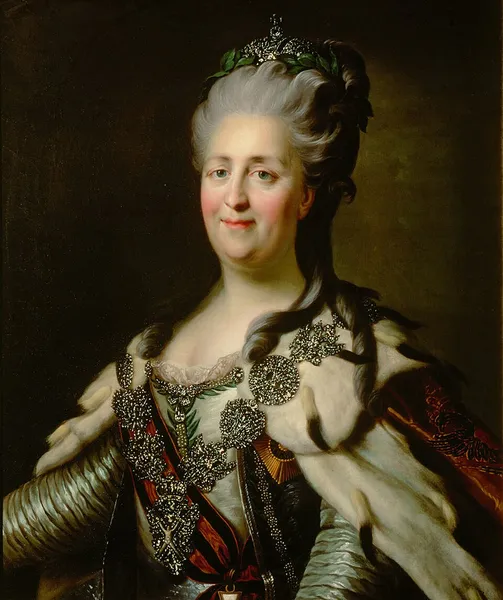
Catherine II (born Sophie Auguste Friederike von Anhalt-Zerbst; 2 May 1729 – 17 November 1796), known as Catherine the Great, was Empress of Russia from 9 July 1762 until her death in 1796. Before her accession, Catherine had been a royal consort as the wife of Emperor Peter III, whom she overthrew in a coup d'état. Her reign of over 34 years saw an era of prosperity during the Enlightenment in which many new cities, universities and theatres were established; large-scale immigration from the rest of Europe occurred; and the Russian Empire was recognised as a great power of Europe. Born a German princess, Catherine married Peter, a grandson of Peter the Great, at the age of 16. Peter became Emperor of Russia in 1762, reigning for seven months before his deposition and possible assassination at the hands of Catherine. During her reign, she often maintained close alliances with noble favourites such as Count Grigory Orlov and Grigory Potemkin. She appointed and worked with several highly successful generals such as Alexander Suvorov and Pyotr Rumyantsev and admirals such as Samuel Greig and Fyodor Ushakov. She governed at a time when the Russian Empire was expanding rapidly by conquest and diplomacy. In the west, she installed her former lover to the throne of Poland, which was eventually partitioned. In the south, the Crimean Khanate was annexed following victories over the Bar Confederation and the Ottoman Empire in the Russo-Turkish War. With the support of Great Britain, Russia colonised the territories of New Russia along the coasts of the Black and Azov seas. In the east, Russians became the first Europeans to colonise Alaska, establishing Russian America. Many cities and towns were founded on Catherine's orders in the newly conquered lands, most notably Yekaterinoslav, Kherson, Nikolayev, and Sevastopol. An admirer of Peter the Great, Catherine continued to modernise Russia along Western European culture. However, military conscription and the economy continued to depend on serfdom, and the increasing demands of the state and of private landowners intensified the exploitation of serf labour.
Also on this shelf
Amharic.
Gothic language.
See also
Uncatalogued shelfText from Wikipedia; plate via Wikimedia Commons. Text CC BY-SA 4.0; plate freely licensed (see Commons). Source record. Images and catalogue data are reproduced from open-access collections.