Writing and Printing
History of Gdańsk
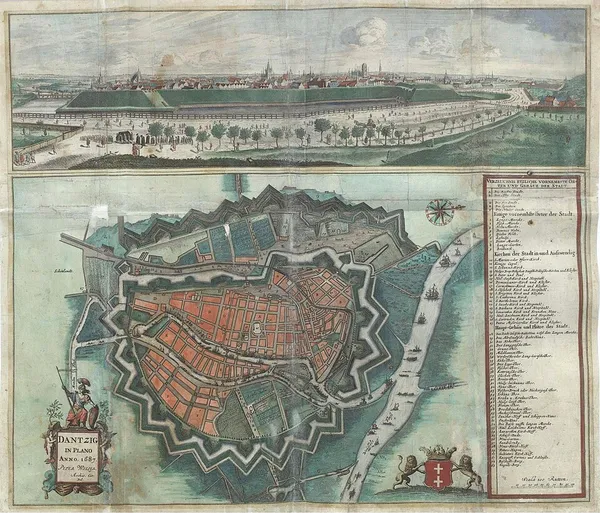
Gdańsk (German: Danzig; Kashubian: Gduńsk) is one of the oldest cities in Poland. Its history begins with an early medieval settlement at the mouth of the Vistula River. A fortified center had been established by the late 10th century, possibly during the expansion of the Piast state under Mieszko I. The city remained part of the Piast state, either directly or as a fief, until the early 13th century, when it came under the rule of the Samborides, who governed Pomerelia as autonomous dukes from 1227. In 1308 the city became part of the Monastic State of the Teutonic Knights until 1454. Thereafter it became part of Poland again, although with increasing autonomy. A vital naval city for Polish grain trade, it attracted people from all over the European continent. After a period of decline, the city was taken over by Prussia during the Second Partition of Poland in 1793 and subsequently regained its importance as a trading port. Briefly becoming a free city during the Napoleonic Wars, it became again part of the Prussian kingdom after Napoleon's defeat, and from 1871 it formed part of the newly created German Empire. After World War I, the Free City of Danzig was created, a city-state under the supervision of the League of Nations. The German attack on the Polish military depot at Westerplatte marked the start of World War II and the city was annexed by Nazi Germany in 1939. After World War II, the city again became part of Poland, and the city's German inhabitants, who had constituted the majority of the city's mixed population before the war, either fled or were expelled to Germany. During the post-1945 era, the city was rebuilt from war damage, and vast shipyards were constructed. The city was a centre of Solidarity strikes in the 1980s, and after the abolishment of communism in 1989, its population faced poverty and widespread unemployment with most of the ship building industry closed down.
Also on this shelf
Bastarnae.
Imphal dialect.
See also
Uncatalogued shelfText from Wikipedia; plate via Wikimedia Commons. Text CC BY-SA 4.0; plate freely licensed (see Commons). Source record. Images and catalogue data are reproduced from open-access collections.