Writing and Printing
Messapic language
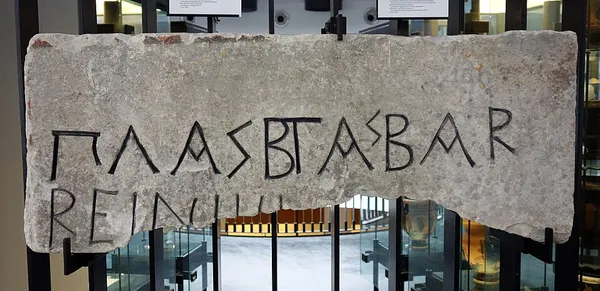
Messapic (; also known as Messapian; or as Iapygian) is an extinct Paleo-Balkanic language of the Indo-European language family once spoken by the Iapygian peoples – the Calabri and Salentini (known collectively as the Messapians), the Peucetians, and the Daunians – in an area that roughly coincided with the modern region of Apulia, in the southeastern Italian Peninsula. Messapic was the pre-Roman, non-Italic language of Apulia. It has been preserved in about 600 inscriptions written in an alphabet derived from a Western Greek model and dating from the mid-6th to at least the 2nd century BC, when it went extinct following the Roman conquest of the region. In current classifications of the Indo-European language family, Messapic is grouped in the same Indo-European branch with Albanian, which is supported by fragmentary evidence that shows common characteristic innovations and notable lexical correspondences, including the partial retention of the Proto-Indo-European three-way dorsal stop contrast, an otherwise rare feature in the Balkan–Adriatic region. Proto-Messapic migration from the opposite Adriatic coast through a trans-Adriatic interaction network is also confirmed by recent archaeological evidence dating to the period between 1700 BCE and 1400 BCE, in the post-Cetina horizon.
Also on this shelf
Hanja.
Genealogy.
See also
Uncatalogued shelfText from Wikipedia; plate via Wikimedia Commons. Text CC BY-SA 4.0; plate freely licensed (see Commons). Source record. Images and catalogue data are reproduced from open-access collections.