Writing and Printing
Greco-Bactrian Kingdom
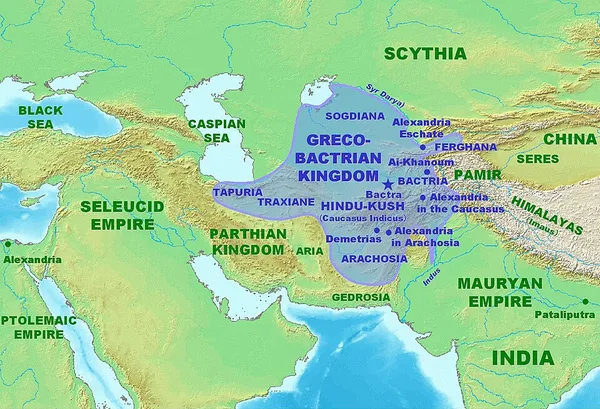
The Greco-Bactrian Kingdom (Greek: Βασιλεία τῆς Βακτριανῆς, romanized: Basileía tês Baktrianês, lit. 'Kingdom of Bactria'), officially the Kingdom of Bactria was a Greek kingdom during the Hellenistic period located in Central Asia and Afghanistan. The kingdom was founded by the Seleucid satrap Diodotus I Soter in about 256 BC, and continued to dominate Central Asia while ruled by the Euthydemid and Eucratid dynasties, until its fall around 120 BC. At its peak the kingdom consisted of present-day Afghanistan, Tajikistan, Uzbekistan and Turkmenistan, and for a short time, small parts of Kazakhstan, Pakistan and Iran. An extension further east, with military campaigns and settlements, may have reached the borders of the Qin State in China by about 230 BC. A Greek population was already present in Bactria by the 5th century BC. Alexander the Great had conquered the region by 327 BC, founding many cities, most of them named Alexandria, and further settling Macedonians and other Greeks. After the death of Alexander, control of Bactria passed on to his general Seleucus I Nicator. The fertility and the prosperity of the region led to the creation of the Greco-Bactrian kingdom under Diodotus by the early 3rd century BC, as a successor state of the Seleucid Empire. The Bactrian Greeks grew increasingly more powerful and invaded north-western India between 190 and 180 BC under king Demetrius, the son of Euthydemus. This invasion led to the creation of the Indo-Greek Kingdom, which in turn was a successor to the Greco-Bactrian kingdom, and was subsequently ruled by the kings Pantaleon and Apollodotus I. Historical records indicate that many rich and prosperous cities were present in the kingdom, but only a few of them have been excavated, such as Ai-Khanoum and Bactra. The city of Ai-Khanoum, in north-eastern Afghanistan, had all the hallmarks of a true Hellenistic city with a Greek theater, gymnasium and some houses with colonnaded courtyards. The kingdom reached its peak under Eucratides the Great, who seems to have seized power through a coup around 171 BC and established his own dynasty. Eucratides also invaded India and successfully fought against the Indo-Greek kings. However, soon the kingdom began to decline. The Parthians and nomadic tribes such as Sakas and Yuezhi became a major threat.
Also on this shelf
Horn of Africa.
Detroit Plaindealer.
See also
Uncatalogued shelfText from Wikipedia; plate via Wikimedia Commons. Text CC BY-SA 4.0; plate freely licensed (see Commons). Source record. Images and catalogue data are reproduced from open-access collections.