Writing and Printing
Freedom of the press in British India
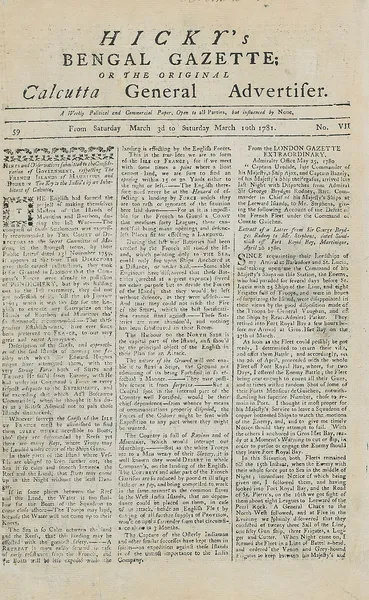
Freedom of the press in British India or freedom of the press in pre-independence India refers to the censorship on print media during the period of the British Raj under the British Crown on the Indian subcontinent from 1858 to 1947. The Indian press was legally protected by the set of laws such as Vernacular Press Act, Censorship of Press Act, 1799, Metcalfe Act and Indian Press Act, 1910, while the media outlets were regulated by the Licensing Regulations, 1823, Licensing Act, 1857 and Registration Act, 1867. The British Raj administrators in the India subcontinent (in modern-day Republic of India, Islamic Republic of Pakistan and People's Republic of Bangladesh) brought a set of rules and regulations into effect designed to prevent circulating claimed inaccurate, media bias and disinformation across the subcontinent. In pre-independence, the government formulated several legal actions, including Gagging Act, comprised a set of rules for publishing, distributing and circulating news stories and operating media organizations working independently or running in the subcontinent. These rules primarily compelled regional and English-language newspapers to express their concerns under the selected provisions. During the period, government allowed a journalist or media industries to cover any story and brought it to the audiences without impacting sovereignty in subcontinent.
Also on this shelf
Controversy over ethnic and linguistic identity in Moldova.
History of Frankfurt.
See also
Uncatalogued shelfText from Wikipedia; plate via Wikimedia Commons. Text CC BY-SA 4.0; plate freely licensed (see Commons). Source record. Images and catalogue data are reproduced from open-access collections.