Writing and Printing
Danish language
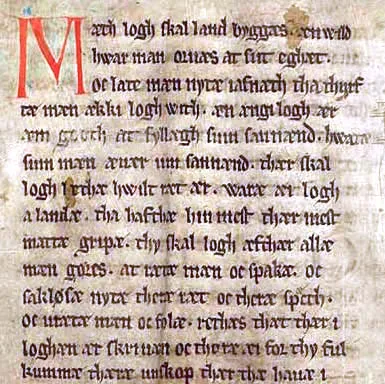
Danish (endonym: dansk pronounced [ˈtænˀsk] , dansk sprog [ˈtænˀsk ˈspʁɔwˀ]) is a North Germanic language from the Indo-European language family spoken by about 5.5 million people, principally in and around Denmark. Communities of Danish speakers are also found in Greenland, the Faroe Islands, Iceland and the northern German region of Southern Schleswig, where it has minority language status. Minor Danish-speaking communities are also found in Norway, Sweden, the United States, Canada, Brazil, and Argentina. Along with the other North Germanic languages, Danish is a descendant of Old Norse, the common language of the Germanic peoples who lived in Scandinavia during the Viking Era. Danish, together with Swedish, derives from the East Norse dialect group, while the Middle Norwegian language (before the influence of Danish) and Norwegian Nynorsk are classified as West Norse along with Faroese and Icelandic (Norwegian Bokmål may be thought of as mixed Danish-Norwegian, therefore mixed East-West Norse). However, the "mainland (or continental) Scandinavian" languages — modern spoken Danish, Norwegian, and Swedish — are largely mutually intelligible with each other, but not with "insular Scandinavian", i.e. Icelandic and Faroese. Although the written languages are compatible, spoken Danish is distinctly different from Norwegian and Swedish and thus the degree of mutual intelligibility with either varies between regions and speakers. Until the 16th century, Danish was a continuum of dialects spoken from Southern Jutland and Schleswig to Scania with no standard variety or spelling conventions. With the Protestant Reformation and the introduction of the printing press, a standard language was developed which was based on the dialect of Copenhagen. It spread through use in the education system and administration, though German and Latin continued to be the most important written languages well into the 17th century. Following the loss of territory to Germany and Sweden, a nationalist movement adopted the language as a token of Danish identity, and the language experienced a strong surge in use and popularity, with major works of literature produced in the 18th and 19th centuries. Today, traditional Danish dialects have all but disappeared, though regional variants of the standard language exist.
Also on this shelf
History of books in Brazil.
Dzzhe.
See also
Uncatalogued shelfText from Wikipedia; plate via Wikimedia Commons. Text CC BY-SA 4.0; plate freely licensed (see Commons). Source record. Images and catalogue data are reproduced from open-access collections.