Writing and Printing
History of the Maldives
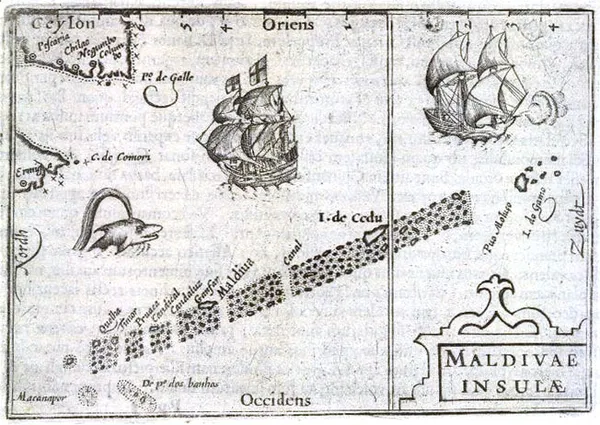
The history of the Maldives is intertwined with the history of the broader Indian subcontinent and surrounding areas in South Asia and the Indian Ocean. The Maldives is formed of 26 natural atolls, comprising 1,194 islands. The Maldives historically has held strategic importance due to its location on the major marine routes of the Indian Ocean. Its closest neighbours are the British Indian Ocean Territory, Sri Lanka, and India. The United Kingdom, Sri Lanka, and some Indian kingdoms in the past have had deep cultural and economic ties with the Maldives for centuries. Maldivians also traded with Aceh and many other kingdoms in what is now Indonesia and Malaysia. The Maldives were a primary source of cowrie shells, which were then used as currency throughout Asia and parts of the East African coast. The Maldives were influenced by the Kalingas of ancient India. The Kalingas were the earliest region of India to trade with Sri Lanka and the Maldives; thus, they were responsible for the spread of Buddhism. Stashes of Chinese crockery found buried in various locations in the Maldives also show that there was direct or indirect trade contact between China and the Maldives. In 1411 and 1430, the Chinese admiral Zheng He (鄭和) visited the Maldives; the Republic of China (Taiwan) later became the first country to establish a resident embassy in Malé in 1966. During the 16th century, when sea faring European colonial powers gained prominence in the Indian Ocean, the Maldives were contacted by the Portuguese the Dutch, and then the French. The Portuguese had occupied the country from 1558 to 1573. The Maldives became a British protectorate in the 19th century. The Maldivian monarchy was granted a degree of self-governance while the British ruled over the country’s external affairs. The Maldives gained independence from the British and became a republic on 26 July 1965. The British continued to operate an air base on the island of Gan in the southernmost atoll which it leased from the Maldivian government until 1976. The British departure in 1976, at the height of the Cold War, almost immediately triggered foreign speculation about the future of the air base.
Also on this shelf
Eurolinguistics.
Judeo-Arabic.
See also
Uncatalogued shelfText from Wikipedia; plate via Wikimedia Commons. Text CC BY-SA 4.0; plate freely licensed (see Commons). Source record. Images and catalogue data are reproduced from open-access collections.