Writing and Printing
Edicts of Ashoka
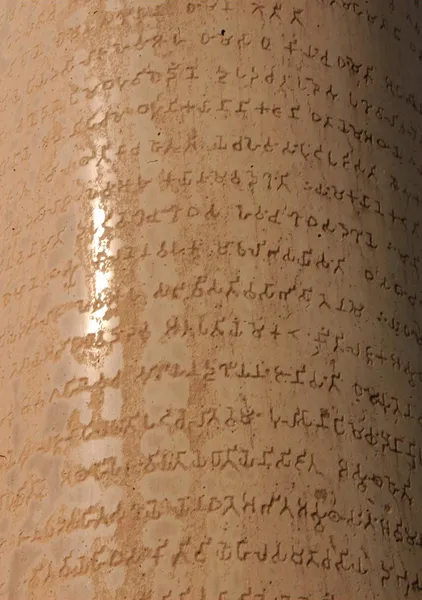
The Edicts of Ashoka are a collection of more than thirty inscriptions on the Pillars of Ashoka, as well as boulders and cave walls, attributed to Emperor Ashoka of the Mauryan Empire who ruled most of the Indian subcontinent from 268 BCE to 232 BCE. These inscriptions were dispersed throughout the areas of modern-day India, Bangladesh, Nepal, Afghanistan and Pakistan, and provide the first tangible evidence of Buddhism. The Edicts are the earliest written and datable texts from India, and, since they were inscribed on stone, we have the added benefit of having them exactly as they were originally inscribed. Earlier texts, such as the Vedic texts, were all composed and handed down orally until later dates. Ashoka used the expression Dhaṃma Lipi (Prakrit in the Brahmi script: 𑀥𑀁𑀫𑀮𑀺𑀧𑀺, "Inscriptions of the Dharma") to describe his own Edicts. The edicts describe in detail Ashoka's policy on dhamma, an earnest attempt to solve some of the problems that a complex society faced. According to the edicts, the extent of his promotion of dhamma during this period reached as far as the Greeks in the Mediterranean region. While the inscriptions mention the conversion of Ashoka to Buddhism, the dhamma that he promotes is largely ecumenical and non-sectarian in nature. As historian Romila Thapar relates: In his edicts Aśoka defines the main principles of dhamma as non-violence, tolerance of all sects and opinions, obedience to parents, respect to brahmins and other religious teachers and priests, liberality toward friends, humane treatment of servants and generosity towards all. It suggests a general ethic of behaviour to which no religious or social group could object. It also could act as a focus of loyalty to weld together the diverse strands that made up the empire. Interestingly, the Greek versions of these edicts translate dhamma as eusebeia (piety) and no mention is made anywhere of the teachings of the Buddha, as would be expected if Aśoka had been propagating Buddhism.’The inscriptions show his efforts to develop the dhamma throughout his empire. Although Buddhism as well as Gautama Buddha are mentioned, the edicts focus on social and moral precepts rather than specific religious practices or the philosophical dimension of Buddhism.
Also on this shelf
Inuit languages.
Canadian women's ice hockey history.
See also
Uncatalogued shelfText from Wikipedia; plate via Wikimedia Commons. Text CC BY-SA 4.0; plate freely licensed (see Commons). Source record. Images and catalogue data are reproduced from open-access collections.