Writing and Printing
Barred lambda
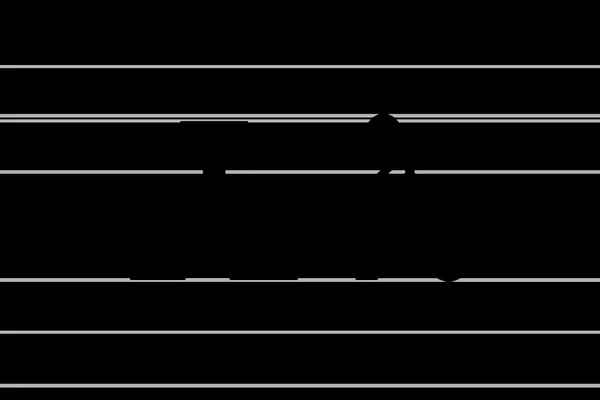
The barred lambda ( ƛ) (U+A7DC LATIN CAPITAL LETTER LAMBDA WITH STROKE, U+019B ƛ LATIN SMALL LETTER LAMBDA WITH STROKE), is a modified letter of the Greek alphabet, commonly encountered in North American linguistics. It is used by the Salishan and Wakashan languages in Canada. In Americanist phonetic notation, it is also known as running man or blam, and is used to transcribe a voiceless alveolar lateral affricate [t͡ɬ]. In physics, it represents the reduced Compton wavelength, i.e. the Compton wavelength λ divided by 2π. It was first used in a phonetics context in American Anthropologist in 1934: λ for [dl] has been used in Eskimo by Jenness ... ƛ for [tł] is an innovation formed from λ as ł from l. It is also used for the affricate [t͡ɬ] in transcribing the Sahaptin language, e.g., iƛúpna ‘he jumped’, and it is commonly used for the same purpose in several languages of the Caucasus, such as Hinuq. In addition, its counterpart with a combining comma above right (U+0315), ƛ̓, is used for many of the Salish languages, such as Klallam, for an alveolar lateral ejective affricate [t͡ɬʼ].
Also on this shelf
Cofán language.
Google Photos.
See also
Uncatalogued shelfText from Wikipedia; plate via Wikimedia Commons. Text CC BY-SA 4.0; plate freely licensed (see Commons). Source record. Images and catalogue data are reproduced from open-access collections.