Writing and Printing
Jawi script
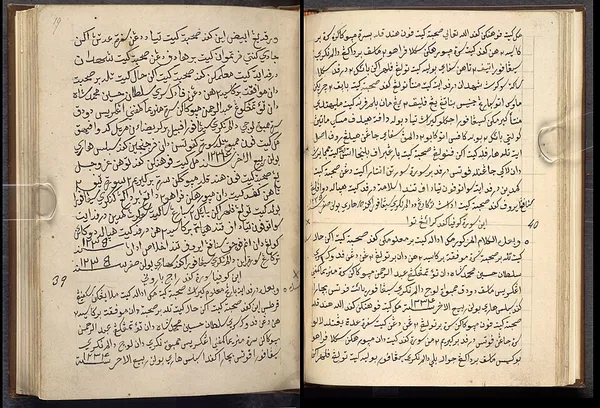
Jawi (جاوي; Acehnese: Jawoe; Acehnese pronunciation: [ɟa.ˈwɔə̯]; Malay: Jawi; Malay pronunciation: [d͡ʒä.wi]) is a writing system used for writing several languages of Southeast Asia, such as Acehnese, Banjarese, Betawi, Iranun, Kutainese, Maguindanao, Malay, Mëranaw, Minangkabau, Tausūg, Ternate, and many others. Jawi is based on the Arabic script, consisting of all 31 original Arabic letters, six letters constructed to fit phonemes native to Malay, and one additional phoneme used in foreign loanwords, but not found in Classical Arabic, which are ca (⟨چ⟩ /t͡ʃ/), nga (⟨ڠ⟩ /ŋ/), pa (⟨ڤ⟩ /p/), ga (⟨ݢ⟩ /ɡ/), va (⟨ۏ⟩ /v/), and nya (⟨ڽ⟩ /ɲ/). Jawi was developed during the advent of Islam in Maritime Southeast Asia, supplanting the earlier Brahmic scripts used during Hindu-Buddhist era. The oldest evidence of Jawi writing can be found on the 14th century Terengganu Inscription Stone, a text in Classical Malay that contains a mixture of Malay, Sanskrit and Arabic vocabularies. However, the script may have been used as early as the 9th century, when the Peureulak Sultanate was established by the son of a Persian preacher. There are two competing theories on the origins of the Jawi alphabet. Popular theory suggests that the system was developed and derived directly from the Arabic script, while scholars like R. O. Windstedt suggest it was developed with the influence of the Perso-Arabic alphabet. The ensuing trade expansions and the spread of Islam to other areas of Southeast Asia from the 15th century carried the Jawi alphabet beyond the traditional Malay-speaking world. Until the 20th century, Jawi was the standard script of the Malay language, and gave birth to traditional Malay literature when it featured prominently in official correspondences, religious texts, and literary publications. With the arrival of Western influence through colonization and education, Jawi was relegated to religious education, with the Malay language eventually adopting a form of the Latin alphabet called Rumi that is currently in general usage. Today, Jawi is one of two official scripts in Brunei. In Malaysia, the position of Jawi is protected under Section 9 of the National Language Act 1963/67, as it retains a degree of official use in religious and cultural contexts.
Also on this shelf
List of newspapers in Italy.
Chu Sigyŏng.
See also
Uncatalogued shelfText from Wikipedia; plate via Wikimedia Commons. Text CC BY-SA 4.0; plate freely licensed (see Commons). Source record. Images and catalogue data are reproduced from open-access collections.