Writing and Printing
Helvetica
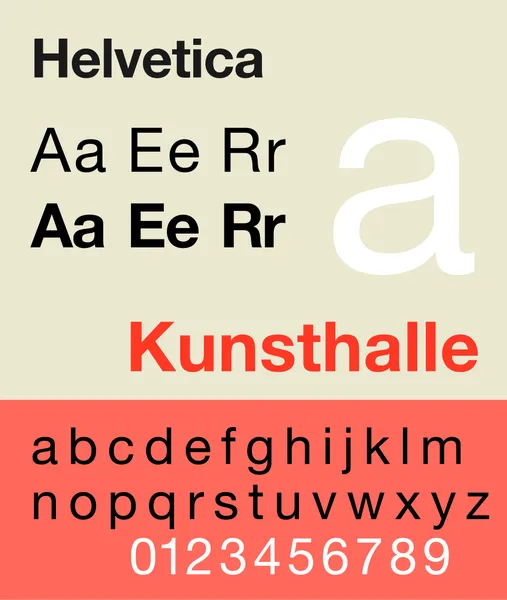
Helvetica, originally named Neue Haas Grotesk, is a widely used sans-serif typeface designed in 1956–1957 by the Swiss typeface designer Max Miedinger under the direction of Eduard Hoffmann, head of the Haas Type Foundry in Münchenstein, near Basel, Switzerland. Helvetica is a neo-grotesque design based chiefly on the 1890s typeface Akzidenz-Grotesk. It has a high x-height, strokes that end on horizontal or vertical lines, and tight letter spacing, which give it a dense, solid appearance. Haas developed it to compete with Akzidenz-Grotesk in the Swiss market, during a revival of interest in grotesque sans-serifs that also produced Adrian Frutiger's Univers. In 1959 the typeface was adapted for Linotype typesetting machines and renamed Helvetica, Latin for "Swiss", at Hoffmann's suggestion; the name also drew on Switzerland's reputation as a center of modern graphic design. It became a hallmark of the International Typographic Style and one of the most popular typefaces of the mid-20th century, and its inclusion as a core PostScript font in the 1980s secured its place in digital typesetting. Many variants have since been released, including Neue Helvetica (1983) and Helvetica Now (2019).
Also on this shelf
History of Somalia.
Bamum script.
See also
Uncatalogued shelfText from Wikipedia; plate via Wikimedia Commons. Text CC BY-SA 4.0; plate freely licensed (see Commons). Source record. Images and catalogue data are reproduced from open-access collections.