Writing and Printing
Evgeni Spalvin
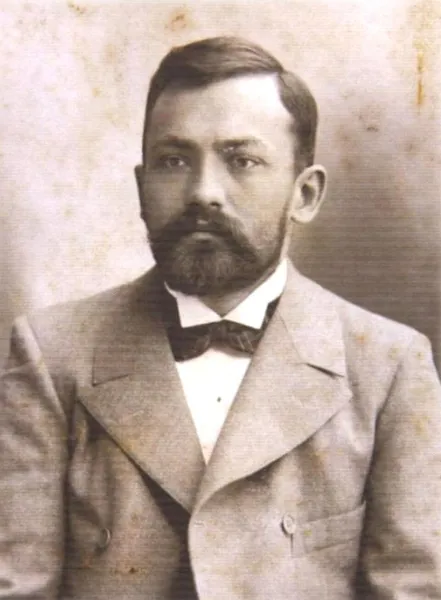
Yevgeny Spalvin (Latvian: Eižens Spalviņš, Japanese: 須春院 or スパルウヰン; 11 October 1872, Ādzele – 10 November 1933, Harbin) was an orientalist and the first professional japanologist in Russia. He was born into the family of a Latvian teacher, began his studies at the Faculty of Law of Petersburg University, and graduated from its Faculty of Oriental Studies in the Chinese-Mongolian-Manchu track. He was sent to Tokyo in 1899–1900 to prepare for a professorship in the department of Japanese literature, and was subsequently sent to Japan on several further occasions (1903, 1906, 1907, 1909, and 1922). After the founding of the Oriental Institute in Vladivostok, he took up the post of professor of Japanese literature there (1900). Until 1920 he combined this post with that of head of the Oriental Institute's library. In 1902–1904, he also served as a censor of the Japanese press and literature and carried out assignments for military counterintelligence. He rose to the rank of Collegiate Councillor (1916, with seniority from 1900) and was awarded the Order of St. Vladimir, 4th class (1917). In 1922–1923, he served as acting rector of the Far Eastern State University. He was cultural secretary and translator for the Soviet plenipotentiary mission in Tokyo (1925–1931), and afterward an adviser to the administration of the Chinese Eastern Railway in Harbin. He died of cardiac arrest following emergency surgery. He was the first professional practical japanologist in Russia. His main efforts were devoted to popularizing the language, to teaching, and to producing textbooks — work to which he dedicated 25 years of his life in total. Besides teaching, he devoted much time to organizational work, notably initiating and serving as chief editor of major orientalist projects — the journals Bulletin of the Oriental Institute and Contemporary Chronicle of the Far East. He is also the author of an original Cyrillic transcription of Japanese phonetics that was used at the Oriental Institute. Despite years of dedicated teaching work, Spalvin, who was not a linguist, did not found a scholarly school and left behind no striking scholarly ideas. In the Soviet period his name was forgotten. The first publications about Spalvin appeared only in the 1980s, and scholarly interest in his life and work, in both Russia and Japan, revived only at the beginning of the twenty-first century.
Also on this shelf
Anti-Cyrillic protests in Croatia.
Al-Hayat.
See also
Uncatalogued shelfText from Wikipedia; plate via Wikimedia Commons. Text CC BY-SA 4.0; plate freely licensed (see Commons). Source record. Images and catalogue data are reproduced from open-access collections.