Writing and Printing
Austronesian languages
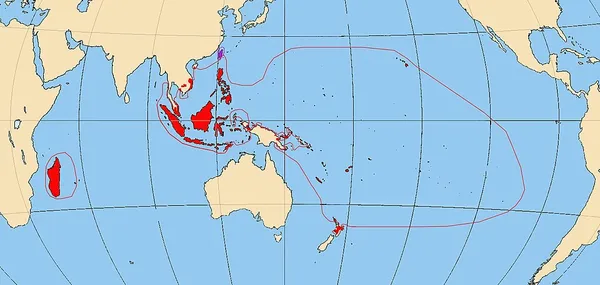
The Austronesian languages ( AW-strə-NEE-zhən) are a language family widely spoken throughout Maritime Southeast Asia, parts of Mainland Southeast Asia, Madagascar, the islands of the Pacific Ocean and Taiwan (by Taiwanese indigenous peoples). They are spoken by approximately 386 million people (4.4% of the world population). This makes it the fifth-largest language family by number of speakers. Major Austronesian languages include Malay (one variant standardized as Indonesian), Javanese, Sundanese, Tagalog (and its standardized form Filipino), Malagasy and Cebuano. According to some estimates, the family contains 1,257 languages, which is the second most of any language family. In 1706, the Dutch scholar Adriaan Reland first observed similarities between the languages spoken in the South East Asia Archipelago and by peoples on islands in the Pacific Ocean. In the 19th century, researchers (e.g. Wilhelm von Humboldt, Herman van der Tuuk) started to apply the comparative method to the Austronesian languages. The first extensive study on the history of the phonology was made by the German linguist Otto Dempwolff. It included a reconstruction of the Proto-Austronesian lexicon. The term Austronesian was coined (as German austronesisch) by Wilhelm Schmidt, deriving it from Latin auster "south" and Ancient Greek νῆσος (nêsos "island"), meaning the "Southern Island languages". Most Austronesian languages are spoken by the people of Insular Southeast Asia and Oceania. Only a few languages, such as Peninsular Malay varieties, Jakun, Temuan, Urak Lawoiʼ and the Chamic languages (except Acehnese), are indigenous to mainland Asia, or Malagasy which is the only Austronesian language indigenous to Insular East Africa. There are few Austronesian languages which have populations exceeding a few thousand, but a handful have speaking populations in the millions; Indonesian, the most widely spoken, has around 252 million speakers, making it the tenth most-spoken language in the world. Approximately twenty Austronesian languages are official in their respective countries. By the number of languages they include, Austronesian and Niger–Congo are the two largest language families in the world. They each contain roughly one-fifth of the world's languages.
Also on this shelf
Cambridge University Press.
Jovan Vladimir.
See also
- ▸Dictionarium Annamiticum Lusitanum et Latinum
- ▸Bunshaft Residence
- ▸English-language press of the Socialist Party of America
Text from Wikipedia; plate via Wikimedia Commons. Text CC BY-SA 4.0; plate freely licensed (see Commons). Source record. Images and catalogue data are reproduced from open-access collections.