Writing and Printing
Geʽez
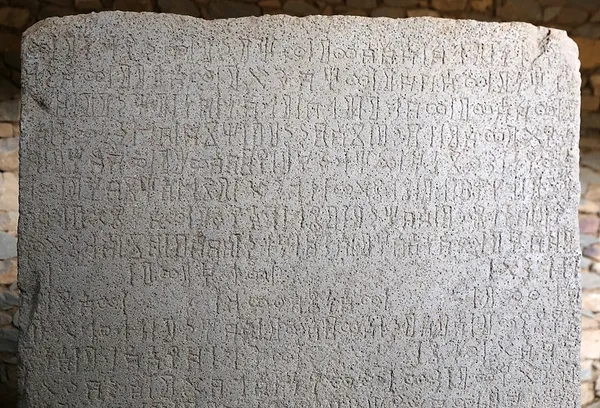
Geʽez ( or ; ግዕዝ Gəʽ(ə)z [ˈɡɨʕ(ɨ)z]), sometimes referred to in scholarly literature as Classical Ethiopic, is an ancient South Semitic language. The language originates from what is now Ethiopia and Eritrea. As of today, Geʽez is used as the main liturgical language of the Ethiopian Orthodox Tewahedo Church, the Eritrean Orthodox Tewahedo Church, the Ethiopian Catholic Church, the Eritrean Catholic Church, and the Beta Israel Jewish community. The first inscription of Ge'ez is from the Hawulti Obelisk in the historic region of Akele Guzay. It is an ancient pre-Aksumite obelisk located in ancient city of Metera in Eritrea. The monument dates tentatively to circa 400 CE in the early Aksumite period and bears the first known example of the ancient Geʽez script. In one study, Tigre (language spoken in Northern Eritrea) was found to have a 71% lexical similarity to Geʽez, while Tigrinya had a 68% lexical similarity to Geʽez, followed by Amharic at 62%. Most linguists believe that Geʽez does not constitute a common ancestor of modern Ethio-Semitic languages but became a separate language early on from another hypothetical unattested common language.
Also on this shelf
Adam of Rottweil.
Geographical distribution of Russian speakers.
See also
Uncatalogued shelfText from Wikipedia; plate via Wikimedia Commons. Text CC BY-SA 4.0; plate freely licensed (see Commons). Source record. Images and catalogue data are reproduced from open-access collections.