Writing and Printing
Konkani in the Roman script
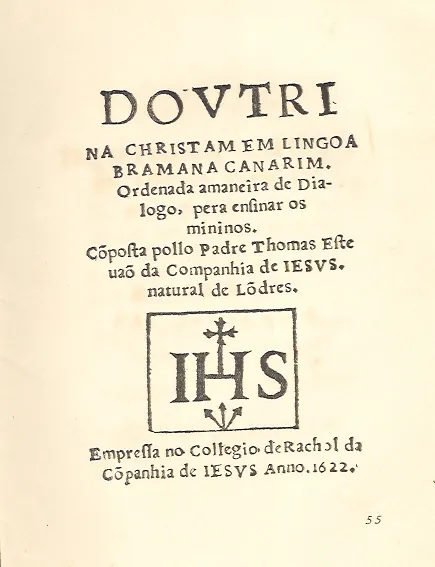
Konkani in the Roman script, commonly known as Roman Konkani or Romi Konknni (Goan Konkani: रोमी कोंक्णी, Rōmī Kōṅkṇī) refers to the writing of the Konkani language in the Roman script. While Konkani is written in five different scripts altogether, Roman Konkani is widely used. Roman Konkani is known to be the oldest preserved and protected literary tradition beginning from the 16th century AD. An estimated 500,000 people use Roman Konkani. The use of Devanagari script for Konkani, which is now its official script, first occurred in AD 1187. Roman Konkani was not mandated as official script by law, for decades even after the Konkani language agitation through the 1960s to 1980s. However in 2013, an ordinance passed by the Government of Goa allows the use of the Roman script alongside Devanagari Konkani and Marathi for official communication. The terms 'Konkani in the Roman script' and 'Roman Konkani' do not merely refer to the fact that the language is written in the Roman script, but they also refer to the dialects traditionally written in this script, namely, the Bardesi (Bardes) and Saxtti (Salcette) variants as opposed to the Antruzi (Ponda) dialect written in Devanagari.
Also on this shelf
Aljamiado.
Eskayan language.
See also
Uncatalogued shelfText from Wikipedia; plate via Wikimedia Commons. Text CC BY-SA 4.0; plate freely licensed (see Commons). Source record. Images and catalogue data are reproduced from open-access collections.