Writing and Printing
Atatürk's reforms
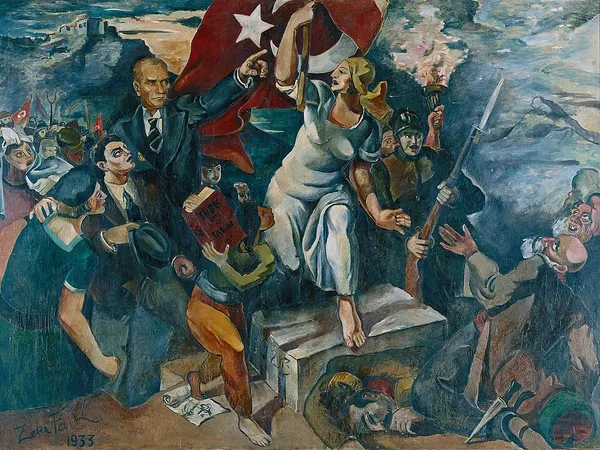
Atatürk's reforms (Turkish: Atatürk İnkılapları or Atatürk Devrimleri, 'Atatürk's Revolution'), also referred to as the Turkish Revolution (Türk Devrimi), were a series of political, legal, religious, cultural, social, and economic policy changes, designed to transform the new Republic of Turkey into a secular, modern nation-state, implemented under the leadership of Mustafa Kemal Atatürk in accordance with the Kemalist framework. The principal political entity, the Republican People's Party (CHP), ruled Turkey as a one-party state from 1923 to 1945, with several exceptions of attempts for a multi-party democracy. Following Atatürk's death in 1938, his successor İsmet İnönü took over the leadership and integrated further Kemalist reforms. İnönü's work was, however, stranded by World War II. The CHP eventually lost the elections to the Democratic Party in 1950, putting an end to the Turkish Revolution. Central to the reforms was the belief that Turkish society had to modernize, which meant implementing widespread reform affecting not only politics, but the economic, social, educational, and legal spheres of Turkish society. The reforms involved a number of fundamental institutional changes that brought an end to many traditions, and followed a carefully planned program to unravel the complex system that had developed over previous centuries. The reforms began with the modernization of the constitution, including enacting the new Constitution of 1924 to replace the Constitution of 1921, and the adaptation of European laws and jurisprudence to the needs of the new republic. This was followed by a thorough secularization and modernization of the administration, with a particular focus on the education system. The literacy rate within the Republic of Turkey, rose from 9% to 33% in only 10 years. The elements of the political system envisioned by Atatürk's Reforms developed in stages, but by 1928, when the last part of Atatürk's Reforms removed the reference to Islam in the Constitution, Turkey became a secular (2.1) and democratic (2.1), republic (1.1) that derives its sovereignty (6.1) from the people. Turkish sovereignty rests with the Turkish Nation, which delegates its will to an elected unicameral parliament (position in 1935), the Grand National Assembly of Turkey.
Also on this shelf
Cartography.
Case (goods).
See also
Uncatalogued shelfText from Wikipedia; plate via Wikimedia Commons. Text CC BY-SA 4.0; plate freely licensed (see Commons). Source record. Images and catalogue data are reproduced from open-access collections.