Writing and Printing
History of Puerto Rico
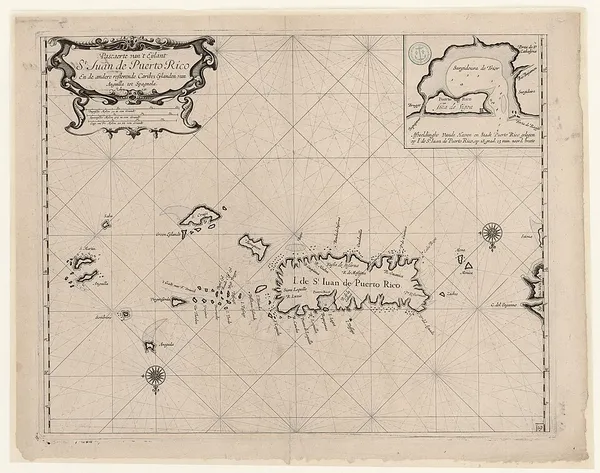
The history of Puerto Rico began with the settlement of the Ortoiroid people before 430 BC. At the time of Christopher Columbus's arrival in the New World in 1493, the dominant indigenous culture was that of the Taíno. The Taíno people's numbers went dangerously low during the later half of the 16th century because of new infectious diseases, other exploitation by Spanish settlers, and warfare. Located in the northeastern Caribbean, Puerto Rico formed a key part of the Spanish Empire from the early years of the exploration, conquest and colonization of the New World. The island was a major military post during many wars between Spain and other European powers for control of the region in the 16th, 17th, and 18th centuries. In 1593, Portuguese soldiers, sent from Lisbon by order of Phillip II, composed the first garrison of the San Felipe del Morro fortress in San Juan. Some brought their wives, while others married Puerto Rican women, and today there are many Puerto Rican families with Portuguese last names. The smallest of the Greater Antilles, Puerto Rico was a stepping-stone in the passage from Europe to Cuba, Mexico, Central America, and the northern territories of South America. Throughout most of the 19th century until the conclusion of the Spanish–American War, Puerto Rico and Cuba were the last two Spanish colonies in the New World; they served as Spain's final outposts in a strategy to regain control of the American continents. Realizing that it was in danger of losing its two remaining Caribbean territories, the Spanish Crown revived the Royal Decree of Graces of 1815. The decree was printed in Spanish, English and French in order to attract Europeans, with the hope that the independence movements would lose their popularity and strength with the arrival of new settlers. Free land was offered to those who wanted to populate the islands on the condition that they swear their loyalty to the Spanish Crown and allegiance to the Roman Catholic Church. In 1898, during the Spanish–American War, Puerto Rico was invaded and subsequently became a possession of the United States. The first years of the 20th century were marked by the struggle to obtain greater democratic rights from the United States. The Foraker Act of 1900 established a civil government, ending rule by American generals and the Department of War.
Also on this shelf
History of rail transportation in the United States.
Catholic Church in Vietnam.
See also
Uncatalogued shelfText from Wikipedia; plate via Wikimedia Commons. Text CC BY-SA 4.0; plate freely licensed (see Commons). Source record. Images and catalogue data are reproduced from open-access collections.